


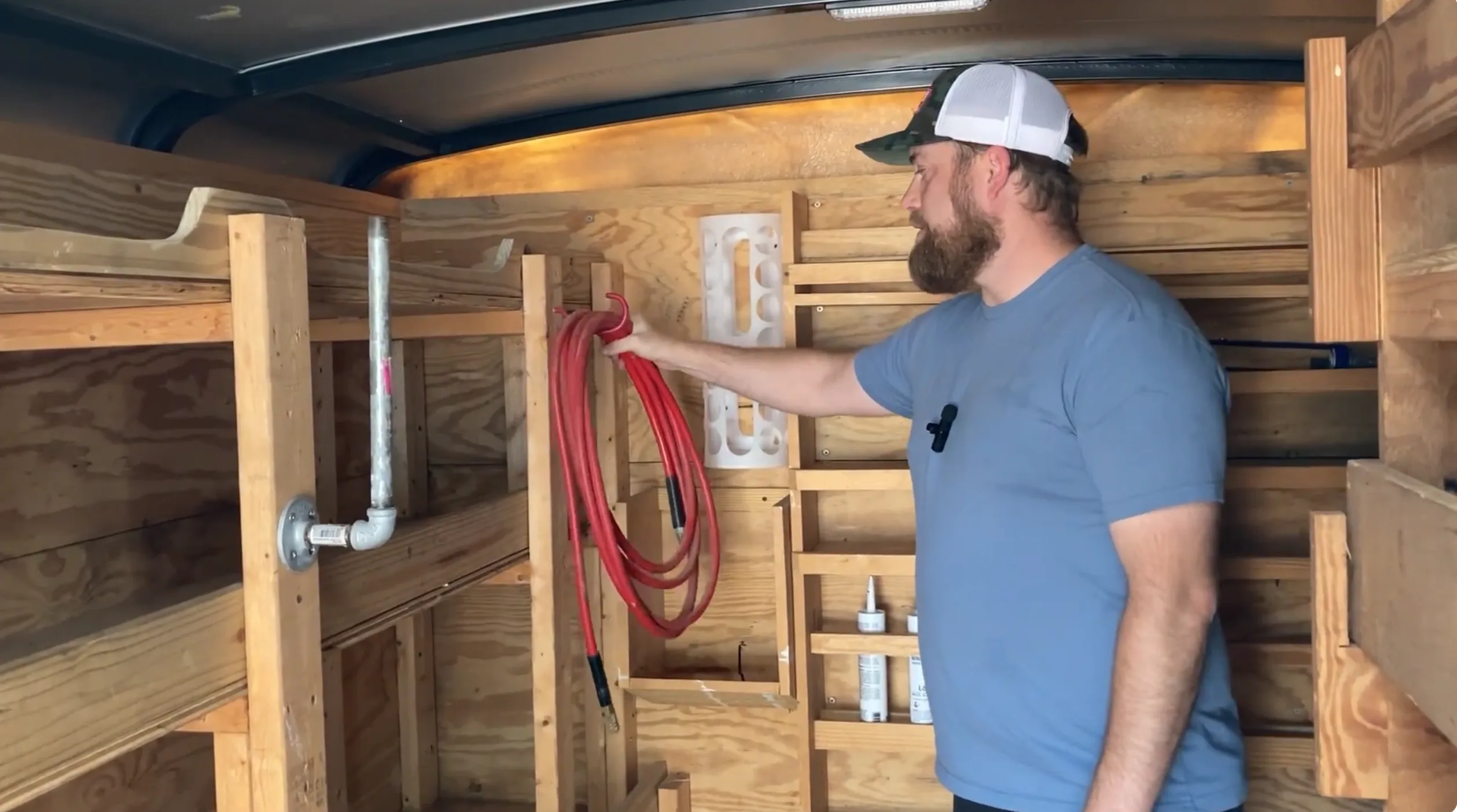
A disorganized enclosed trailer costs you time every single day. When you're digging through piles of tools to find a box of screws or untangling cords that should have been hung up, that's time you're not billing for.
The right storage setup puts every tool in a dedicated spot and makes the things you use most accessible without dropping the ramp. This guide covers practical storage ideas, shelving options, and a step-by-step planning process to help you build a trailer layout that works for your trade.
Full trailer walkthrough: DIY tool storage build
Enclosed trailer tool storage ideas that maximize space and organization
Wall-mounted shelving, modular bins, E-track systems, overhead racks, and other storage methods can all help keep tools organized and accessible without eating up floor space.
A well-planned layout organizes daily-use items within arm's reach. When every tool has a dedicated spot, you spend less time digging through piles and more time working. That's the real payoff here—not just a tidy trailer, but a faster workday.
Wall-mounted shelving and storage racks
Wall shelving keeps tools, fasteners, and supplies off the floor where you can see and grab them quickly. You can build custom shelves around your actual tool sizes, whether that's boxes of nails, caulk tubes, or the power tools you reach for every day.
However, most enclosed trailers have thin walls that won't hold much weight on their own. Before mounting anything, locate the wall studs or add plywood backer boards to distribute the load. A shelf that pulls out of the wall creates a mess and a safety problem.
Modular bins, totes, and bucket racks
Modular storage refers to removable, stackable, or adjustable containers that can change with the job. Five-gallon buckets, tool totes, and other tools you use on every job can stay in designated spots—but fluctuating materials for each jobsite need the flexibility of modular systems.
If you're hauling sheetrock one day and running a service call the next, modular bins let you reconfigure without tearing out permanent shelving.
Simple DIY holders for cords, hoses, tape, and small tools
Some of the most useful storage solutions cost almost nothing. Hooks for air hoses and drop cords, PVC tubes for brooms or pole sanders, and drilled holes for bits or small tools can turn dead wall or divider space into functional storage.
A few low-cost options that work well:
- Small PVC or metal pipes: Hold rolls of tape upright
- Scrap wood racks: Organize caulk tubes or keep nail boxes from sliding
- Cup hooks: Hang extension cords, air hoses, or safety glasses
- Sections of large PVC pipe: Store brooms, levels, or long-handled tools vertically
Wall-mounted pegboards and tool panels
Pegboard and slat-wall systems offer visibility and quick access for hand tools. You can rearrange hooks and holders as your tool collection changes, which makes pegboard more flexible than fixed shelving for smaller items.
Mount pegboard to reinforced wall panels or directly into studs. Pegboard alone won't support much weight without proper backing behind it.
Foldable workbenches and drop-down tables
A fold-down workbench creates workspace when you need it and stows flat during transport. Contractors who cut materials, prep supplies, or charge batteries inside the trailer during rain or bad weather—especially in an insulated trailer—get real use out of a folding work surface. Look for designs with sturdy hinges and leg supports. A workbench that wobbles or collapses under load isn't worth the space it saves.
If you can’t fit a foldable workbench, consider leaving the top shelf of one of your built-in systems empty. You can use the space to temporarily set down tools and work on small hand projects.
V-nose cabinets and front workbench setups
The v-nose is the angled front section on v-nose enclosed trailers. This space is ideal for cabinets, a fixed workbench, charging stations, or small tool storage that doesn't eat into your main floor area.
Overhead bins and ceiling racks
Overhead storage uses space that would otherwise sit empty. It works best for lightweight, less frequently used items like safety gear, tarps, or seasonal supplies. Keep clearance in mind: you’ll want to have the vertical space to move safely through the trailer without the backache of ducking under low-hanging bins.
Interior ladder racks and long material storage
Ceiling-mounted or side-mounted racks handle ladders, lumber, trim, conduit, and pipe without taking up floor space. If you regularly haul long materials, consider leaving one wall more open instead of filling both sides with permanent shelving. You can still organize tools on one side, while keeping the other available for sheet goods or framing lumber.
LED interior lighting
Good lighting makes a real difference when you're loading before dawn or working inside the trailer during overcast weather. Battery-powered or wired LED strips near workbenches, side doors, and storage areas help you find what you need quickly.
Wired systems are more reliable for daily use, but battery-powered options work well as backup or in trailers without electrical hookups.
Best shelving options for an enclosed trailer
Shelving forms the foundation of most cargo trailer organization systems. The right choice depends on what you haul, how much weight you're storing, and whether you need flexibility for different jobs.
| Material | Weight Capacity | Cost | Best For |
| Wood | Moderate | Low | Custom builds, DIY setups |
| Steel | High | Medium | Heavy tools, equipment |
| Aluminum | Moderate-High | High | Lightweight solution |
| Aluminum cabinetry | High | Premium | Closed storage |
Wood shelving
Wood is affordable and easy to work with, making it popular for DIY builds. You can cut shelves to exact dimensions for specific tools, buckets, or boxes.
The drawbacks are weight and moisture sensitivity. Wood shelving adds more pounds than aluminum, and it can warp in humid conditions over time.
Metal shelving
- Steel shelving handles heavier loads than wood and resists moisture better.
- Aluminum shelving weighs less than steel and won't rust, though it costs more upfront.
Many metal shelving systems offer adjustable shelf heights, which adds flexibility as your storage needs change.
Aluminum cabinetry
Aluminum cabinets represent the premium option—durable, professional-looking, and often lockable for better trailer security. They cost significantly more than DIY alternatives but last longer and contribute to resale value.
How to use E-track for tool storage
E-track is one of the most flexible storage upgrades you can add to an enclosed trailer. The rails have slotted openings that accept straps, hooks, baskets, shelf brackets, and other accessories, so you can secure larger equipment and organize smaller tools without building everything into one permanent layout.
The biggest advantage is adjustability. As your tools, materials, or job needs change, you can move accessories up, down, or across the rail instead of tearing out shelving or drilling new holes every time.
Horizontal E-track for tie-downs
Horizontal E-track is commonly installed along trailer walls to create multiple anchor points for straps. This is useful for securing compressors, table saws, generators, toolboxes, ladders, and other large items that could slide or tip during transport.
For heavier equipment, use properly rated straps and attach them at stable points on the tool or frame. E-track can help prevent load shift, but only when it is mounted securely to the trailer structure and paired with the right tie-down hardware.
Vertical E-track for hanging tools
Vertical E-track strips work well for hanging and organizing frequently used tools. Hooks, baskets, holders, and brackets can be moved as your setup changes, which makes vertical E-track a good option for cords, hoses, battery tools, levels, extension handles, and small parts.
It is especially useful in trailers where wall space is limited. Instead of giving one item a permanent spot, you can adjust the layout based on the season, trade, or type of job you are hauling for.
E-track accessories worth adding
- Strap anchors: Create tie-down points for large tools, equipment, and rolling items during transport.
- Tool hooks: Hold power tools, extension cords, air hoses, drop cords, and other items that tangle easily.
- Parts baskets: Store hardware, fittings, fasteners, safety gear, and small supplies where they are easy to see.
- Shelf brackets: Support adjustable shelves for toolboxes, bins, cases, and materials.
- D-rings and rope rings: Add quick connection points for straps, bungees, and light-duty tie-offs.
- Wood beam sockets: Let you create removable dividers or supports for odd-shaped cargo.
How to plan your enclosed trailer tool storage layout
Taking time to plan before buying or installing storage prevents wasted money and frustrating do-overs. A layout that works on paper might fail in practice if you skip the planning steps.
Step 1: Inventory your tools and materials
List every item you transport regularly. Group them by size, weight, and how often you use them. This inventory becomes the foundation for your entire layout.
Step 2: Map daily-use and occasional-use zones
Place frequently used tools within arm's reach. Frequently used items belong near the side door so you don't have to drop the ramp every time. Nails, paint, buckets, tape, caulk, and cords are common candidates for side-door access. Reserve rear, overhead, and harder-to-reach areas for items you only need occasionally.
Step 3: Leave space for the materials you haul most
Tool storage shouldn't take over the trailer if you still need room for sheetrock, lumber, or pipe. Some contractors keep storage on one wall and leave the other side open for materials.
Step 4: Reinforce walls before mounting storage
Most enclosed trailers have thin walls that won't support heavy loads without reinforcement. Add plywood backer panels or locate wall studs before drilling.
Pro tip: Use a stud finder before drilling. Missing a stud can mean your shelf pulls out of the wall during transport.
Step 5: Plan to place heavy items low, centered, and forward
Weight distribution affects towing stability. Heavy tools and materials placed high on shelves or concentrated at the rear can cause trailer sway.
Step 6: Install electrical, then large systems, then small accessories
If you're going to wire your enclosed trailer or install a generator, try to do it before the storage is built out. Shelving, cabinets, E-track, and workbenches go in before hooks, holders, baskets, and small storage details. Working from wiring, to large, to small prevents having to uninstall items.
Build your tool storage trailer with Ken Feagin Truck & Trailer
Good storage setup starts with the right trailer. The enclosed trailer size, door configuration, wall construction, and available electrical options all affect what kind of organization system you can build inside.
At Ken Feagin Truck & Trailer, we carry enclosed and cargo trailers from brands like Homesteader, Choice Cargo, and E-Z Hauler in sizes that work for contractors, landscapers, and tradespeople throughout the Carolinas. We can help you choose a trailer that fits your tow vehicle, your storage needs, and your budget—before you start building out the interior.
If you're ready to find the right enclosed trailer for your work, come on by or give us a call. We're located in Campobello, SC, off exit 5 on I-26.
Browse Enclosed & Cargo Trailers →
FAQs about enclosed trailer tool storage
What is the best flooring to put in an enclosed trailer used for tool storage?
Rubber mats or coin-pattern vinyl are common choices. They protect the plywood subfloor from moisture and damage while making cleanup easier after muddy or dusty jobs. Both are also simple steps in ongoing trailer maintenance that help protect your build-out over time.
How do you mount shelving without damaging enclosed trailer walls?
Locate wall studs or add plywood backer boards to distribute weight. Mounting directly into thin wall panels often results in pull-through under load.
How much cargo weight can an enclosed trailer safely hold for tool storage?
It depends on the trailer's GVWR minus the empty trailer weight. Check the VIN sticker or manufacturer specs for your specific trailer's limits.