


Classic cars take a lot of TLC to preserve their value and beauty. For serious owners, that means years of restoration, maintenance, and carefully checking the weather before an afternoon drive.
When it comes to hauling your classic car, your choice of car hauler affects how safely you can load, how smoothly the car rides, how much cleanup you deal with after a trip, and how secure the vehicle stays when parked. A trailer that fits your car and your use case will save you money and headaches for years.
This guide lists the trade-offs between open and enclosed trailers, the size and loading factors that matter most, and the security upgrades that give you peace of mind.
Open vs. enclosed trailers for hauling classic cars
The choice between an open and enclosed trailer for hauling a classic car comes down to how often you tow, how far you travel, and how much protection you want.
Open trailers are best for simple hauling and shorter trips
Open trailers are a practical fit for local or occasional hauling because they cost less, tow lighter, and make loading easier, but they leave your classic car exposed to weather and road debris.
Open trailer pros
- Costs less up front than an enclosed trailer
- Weighs less, which can make towing easier on your vehicle
- Makes loading and tie-down checks easier because you can see the car from all sides
- Works well for local hauling, short trips, and occasional use
Open trailer cons
- Leaves your classic car exposed to rain, road debris, dust, and grime
- Increases cleanup after trips, especially on highways
- Offers less protection for paint, trim, and finish
- Doesn’t offer long-term storage
- Makes less sense for fresh restorations or higher-value collector cars
Enclosed trailers are best for protection and storage
Enclosed trailers are the better choice when protection and storage matter most because they shield your car from the elements during travel and can double as a secure place to keep it between trips.
Enclosed trailer pros
- Protects your car from rain, road spray, loose gravel, dust, and sun exposure while towing
- Helps preserve paint, trim, and finish, especially on longer highway trips
- Adds security when the trailer is parked
- Can double as a secure storage space if garage space is limited
- Can reduce outside storage costs over time
Enclosed trailer cons
- Costs more up front than open trailers
- Weighs more, which can require more tow vehicle capacity
- Can be tighter to load and exit without the right escape door setup
- Takes up more space to store when not in use
Shop Ken Feagin Truck & Trailer's open and enclosed car haulers →
How to choose trailer size and capacity that fits your classic car
A trailer can look large enough on paper and still be a poor fit once you factor in the car’s length, width, ride height, and loading clearance.
Here are the trailer specs to consider before committing:
- Verify your vehicle weight: use factory specs or a scale weight if the car has modifications.
- Confirm trailer GVWR and payload: make sure payload covers the car plus your gear.
- Measure overall length: include bumper extensions or anything that adds length.
- Measure the widest point: body width and tire width matter more than mirrors in most cases.
- Check ride height and clearance: low-clearance cars need better loading angles.
- Confirm your tow vehicle rating: match your truck to the loaded trailer weight, not just empty trailer weight.
Many collectors choose to size up once they evaluate the loading room in person, so make sure to compare the specs on multiple trailers to see which would fit your car and loading preferences the best. A little extra trailer space helps with loading and tie-downs, especially on enclosed trailers where door clearance matters. You want a trailer that handles the car comfortably, not one that runs at the edge of its ratings every trip.
Loading features that protect your classic car
A lot of damage can happen during loading and unloading, not just while towing down the road. Front valances scrape, rockers catch on ramps, and doors get dinged inside enclosed trailers. The right loading features can reduce the risks to your car and your blood pressure.
Low-angle loading for classic cars
Many classic cars sit lower than modern vehicles, and steep ramps aren’t compatible. A power tilt deck is one of the best features you can buy for low-clearance loading because it reduces the angle and gives you a smoother path onto the trailer. That helps protect the front end, exhaust, and underbody during loading and unloading.
If you load by yourself, a power tilt setup also makes loading easier since you are not dealing with loose ramps and sharp angles at the same time.
Learn more: Tilt Trailer vs. Ramps: Which Is Right For You?
Gull-wing wall or escape door
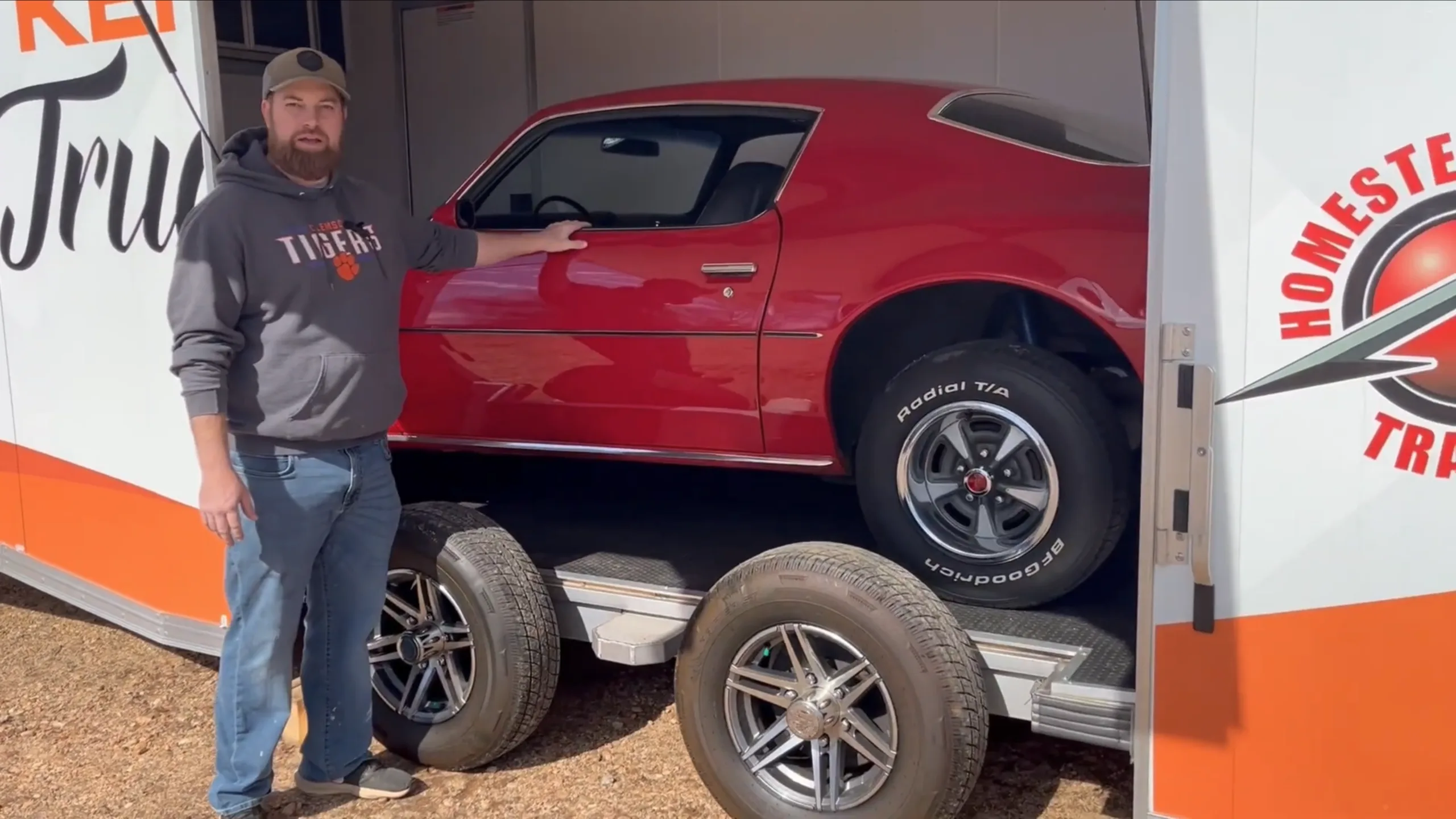
On enclosed trailers, the question is not just whether the car fits. It is whether you can get out of it once it is inside. Tight side clearance forces people to squeeze out of the door opening or climb out the window, which gets old quickly and raises the chance of scratching a door edge.
A good escape door setup fixes that. Some enclosed trailers use a standard side escape door, and some offer a larger side opening or a gull-wing style wall that lifts for much better access. That larger opening gives you room to open your vehicle door wider and step out safely without hitting the trailer wall. It is especially helpful if you are hauling a wider classic car or truck, or if mobility and comfort matter.
Pro tip: Bring your vehicle to the dealership and test door clearance in person. A trailer can look right on paper and still feel tight once the car is loaded.
Evaluating flooring, tie-down set-ups, and suspension
Flooring, tie-down layout, and suspension shape how safely your car is secured, how well the trailer holds up over time, and how much movement or vibration your car takes on the road. If you want to avoid damage and get a trailer that stays reliable long term, this is where it pays to slow down and look closely.
Flooring
Your choice of flooring affects both the durability and traction of your trailer.
On open trailers, an all-steel deck is a popular option because it is durable and won’t rot like wood. However, check how the texture of the deck affects traction. You want a deck surface that gives you secure footing while loading and tying down your classic car.
On enclosed trailers, the strength of the floor matters most. You want a floor that stays solid under repeated loading and supports your tie-down points without flexing or wearing out early. If you are shopping for a used trailer, inspect the floor closely for soft spots, corrosion, or repairs that suggest long-term moisture issues.
Tie-down setup
Classic cars do not all sit the same on a trailer. Wheelbase, tire size, and body style change where your straps need to land. A trailer with multiple D-ring locations gives you better strap angles and makes it easier to secure different vehicles safely. You want options at the front, middle, and rear when possible.
Here’s what to check:
- Confirm multiple D-ring positions
- Inspect welds and mounting points
- Verify the strap angles are compatible with your car
- Ask about added tie-down options if needed
Pro tip: Strong hardware mounted to a weak structure still creates a weak point. Look for solid mounting and clean welds, and ask about adding more tie-down points if your vehicle needs a specific setup.
Suspension
Suspension is one of the biggest differences between a basic trailer and one that treats a classic car like it should.
- Standard leaf spring suspension can work fine, but it usually rides rougher.
- Torsion axles provide a smoother ride and help reduce bouncing because each wheel responds more independently.
If you are hauling a car with older suspension or fragile trim, that smoother ride is worth paying for. You will feel the difference in towing, and your car will feel the difference after a long trip.
Security features worth prioritizing for your classic car
A classic car attracts attention, and a trailer without proper locks is an easy target. Here are the features we recommend:
- A bar lock on the side entry door that adds stronger protection than a basic latch.
- A rear ramp door lock that secures the main access point on enclosed trailers.
- A tongue lock that helps prevent trailer theft when parked.
- A matched-key lock setup that keeps your loading and unloading smooth with one key for the side door, rear ramp, and tongue lock.
These upgrades are especially helpful if you travel to shows, park overnight, or store the trailer outside. At Ken Feagin Truck & Trailer, our enclosed trailers are fitted with Proven Industries locks so you have a stronger, more convenient, and well-tested security setup from the start.
Learn more: Trailer Security 101: How to Secure Your Trailer and Prevent Cargo Theft
Hauling your classic car vs. using a transportation service
If you move your classic car more than occasionally, it’s generally best to haul it yourself. You stay in control of how the car is loaded, strapped down, towed, and parked, which matters when you care about ride height, paint, trim, and overall handling. You also avoid working around a transport company’s timing, which makes local shows, shop visits, and weekend trips much easier to plan.
A transport service can still be useful for a one-time long-distance move, especially if you do not have a tow vehicle or space for a trailer. But if you expect to move the car several times a year, owning a trailer gives you more flexibility and better long-term value.
Haul it yourself if you:
- Move the car several times a year
- Want control over loading and tie-downs
- Need the trailer to double as storage
- Travel to local or regional events often
Confidently haul your classic car with a trailer from Ken Feagin Truck & Trailer
The best trailer for your classic car is the one that fits your vehicle, your hauling habits, and the level of protection you want on the road and while parked. When the loading angle, tie-down setup, suspension, and security are right, towing is safer and ownership is easier.
At Ken Feagin Truck & Trailer, you can compare both open and enclosed car haulers and choose the setup that fits your needs, with practical options like escape door upgrades, smoother suspension, and Proven Industries locks for stronger trailer security. If you want help choosing a trailer that protects your car and holds up well long term, talk with our team or visit us in Campobello, SC, right off Exit 26 on I-26.
Shop Ken Feagin Truck & Trailer's open and enclosed car haulers →
You might also like: