


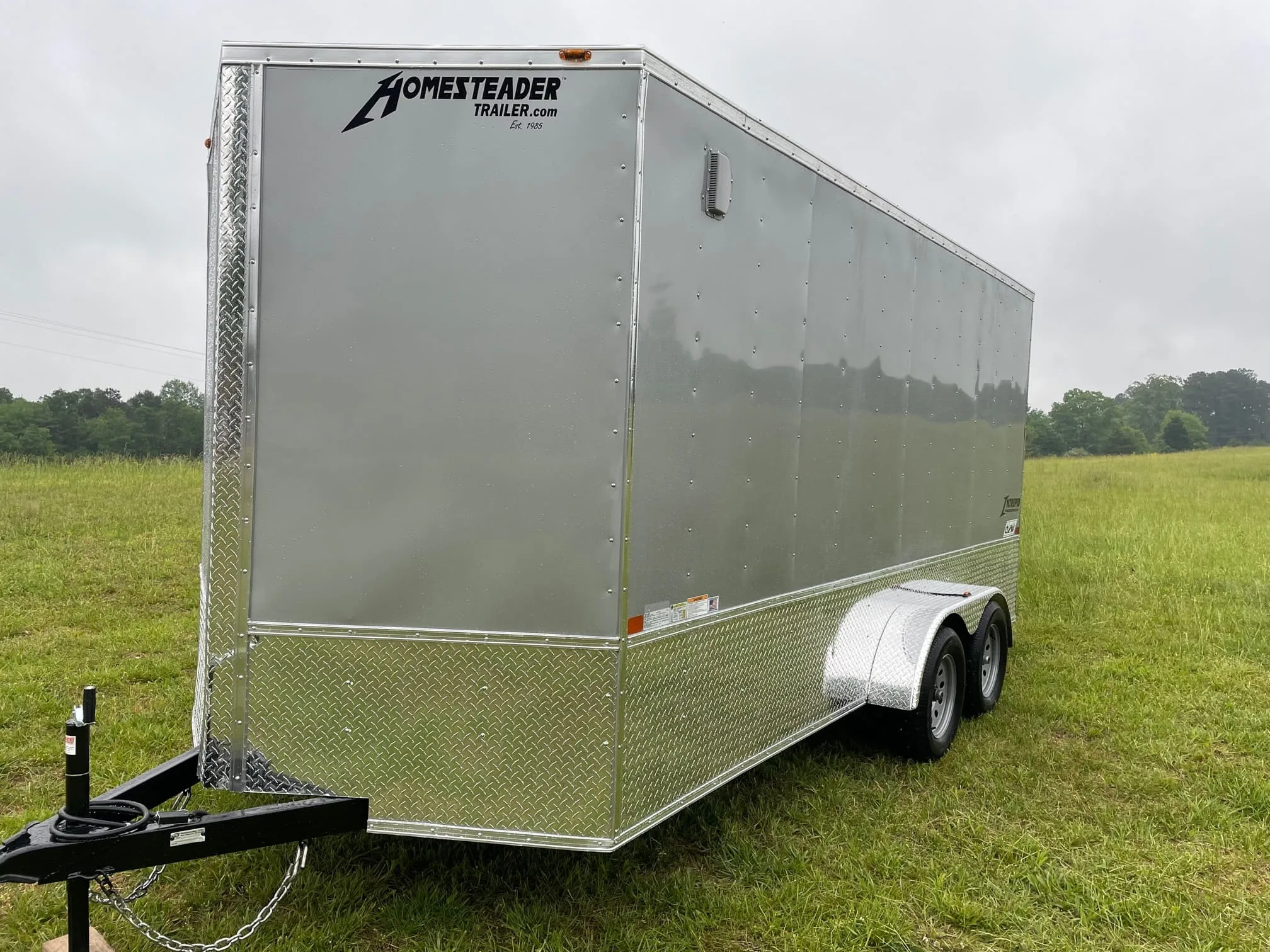
Looking for an enclosed trailer? You’ve probably noticed some have a V-shaped front while others have a flat wall. When choosing between trailer types, it's important to know the shape of the nose isn’t the only difference between these models. In fact, there are lots of reasons trailer owners prefer one type over another.
We’ll break down how V-nose and flat-front trailers compare and answer the most common questions related to interior space, exterior length, tongue space, maneuverability, aerodynamics, customization, and cost, so you can decide which type fits your needs.
What is a V-nose trailer?
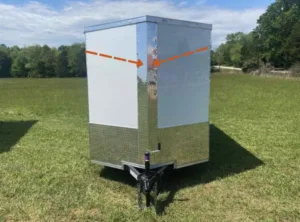
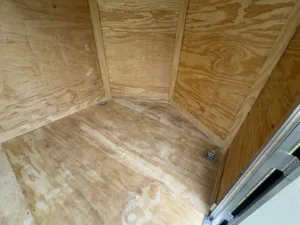
The front of a V-nose trailer tapers into a V shape, adding angles on both the interior and exterior of the trailer. This creates a narrower section at the front of the cargo area.
Like any trailer, a V-nose model can also have different doors, ramps, flooring, tie-downs, and other equipment. The V-nose itself only tells you what the front of the trailer looks like.
How are V-nose trailers measured?
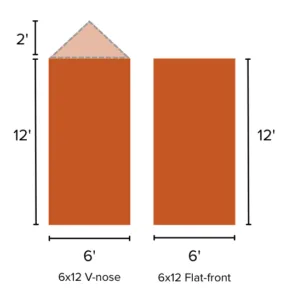
V-nose trailers are usually measured by their rectangular box length. A tapered front adds ~2’ to the length of the trailer, but the advertised measurement often does not include this extra length. For example, if you see a V-nose trailer listed as having a 20’ length, the actual length may be closer to 22’.
What is a flat-front trailer?
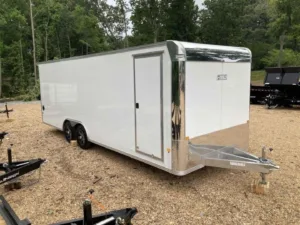
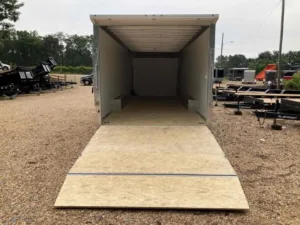
Flat-front trailers, sometimes called flat-nose trailers, have a straight wall across the front of the cargo box. The walls run straight from the rear doors to the front, giving the trailer a rectangular cargo area.
These trailers are common in enclosed cargo and equipment applications and come in a range of lengths, widths, heights, and weight ratings. The interior can be configured with different doors, ramps, flooring, tie-downs, shelving, and other equipment depending on the trailer.
“Flat-front” only refers to the shape of the front of the trailer. It doesn't tell you the trailer's size, weight capacity, axle rating, or other features.
V-nose trailer vs. flat front trailer
A V-nose and flat-front trailer can have the same advertised cargo length but work very differently for the person towing and using them. The front design affects how you use the interior, how much space the trailer takes up, where you can add equipment, and how it performs on the road.
Does a V-nose trailer give you more interior space?
A V-nose can provide more total interior space, but the shape of that space should be kept in mind.
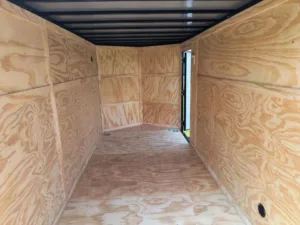
The tapered front gives you extra room beyond the main rectangular cargo area. That space can be useful for storing smaller items, tools, shelving, cabinets, or other equipment. However, the narrowing shape limits what you can load into the nose.
What about a flat-front?
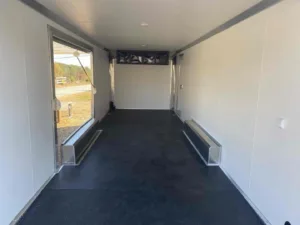
A flat-front design can be more useful when you're loading:
- Wide equipment
- Square equipment
- Pallets
- Large boxes
- Items that need to sit flat against the front wall
When comparing the two, consider the dimensions and shape of the equipment you actually plan to carry. More interior space does not always mean more usable cargo space.
For example, a contractor who wants a workbench and organized tool storage may be able to put the V-nose area to good use. A landscaper carrying wide equipment may get more practical value from an uninterrupted rectangular floor.
Do flat-front trailers give you more room on the tongue?
If you want to use the trailer tongue for a toolbox, generator, propane tanks, batteries, or other equipment, a flat-front trailer can give you more room to work with.
The V-nose extends forward into the area above the tongue, which can limit the space available for tongue-mounted equipment. Depending on the trailer, you may need an extended tongue to create enough room for certain accessories or storage options.
That extra tongue space can be useful if you already know you want to carry equipment outside the trailer. Before you buy, look at the tongue layout and measure the space available for anything you plan to mount there.
Learn more: What is Tongue Weight? A Guide for Safer Towing
Does a V-nose trailer pull better?
A V-nose trailer can be easier to maneuver when making turns or navigating tight spaces. The tapered front gives you a narrower leading edge, which can be helpful when backing into a space or working around obstacles.
The trailer’s overall length, axle placement, weight, and your tow vehicle also affect how easily it handles. A V-nose does not automatically make every trailer easier to maneuver, so consider the trailer’s full dimensions and design when comparing options.
Are V-nose trailers more aerodynamic?
Aerodynamics are one reason people consider a V-nose trailer. A tapered front can reduce some of the aerodynamic drag created by a flat-front trailer, particularly at highway speeds.
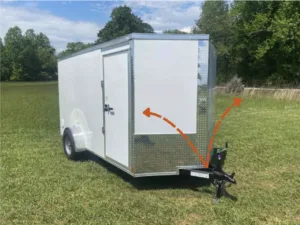
But that doesn't mean you can count on a specific MPG improvement. Your tow vehicle, trailer height and width, loaded weight, speed, wind, road conditions, and driving habits all affect fuel mileage.
If you regularly spend hours on the interstate with an enclosed trailer, the aerodynamic difference is worth considering. If most of your towing consists of short trips around town, the trailer's size, cargo layout, and intended use may matter more to your decision.
Are flat-front trailers easier to customize?
Both trailer styles can be customized, but a flat-front design can make certain modifications easier to plan and install.
The straight front wall gives you a consistent, full-width surface for shelving, cabinets, workbenches, E-track, and other interior additions. You also don't have to work around the angled walls of a V-nose when planning where those features will go.
A V-nose can still be customized with shelving, cabinets, tools, parts, or a workbench, taking advantage of the extra length in the nose. However, the tapered shape can limit the size and placement of some modifications.
If you have a specific interior layout in mind, measure the space and consider how the front wall will affect your plans before choosing between the two designs.
Do V-nose trailers cost more?
There isn't a set price difference for choosing one front design over the other. The cost difference depends on the manufacturer, trailer size, construction, and included equipment.
When comparing prices, look at the entire trailer rather than paying for the nose shape alone. Compare the construction, axle setup, GVWR, payload capacity, interior dimensions, doors, ramp, and included equipment. The right choice depends on how those features fit the work you plan to do with the trailer
Learn more: Towing Terms - Know Your Numbers
How to choose between a V-nose and flat-front trailer
Ask yourself these questions before you choose:
- What are you hauling? Measure your largest equipment, including its width, length, and height.
- What shape of space do you need? Decide whether the tapered front or full-width rectangular floor works better for your cargo.
- How will you use the front? Consider whether you want space for shelves, cabinets, a workbench, or smaller equipment.
- How much highway towing will you do? Frequent highway towing may give you more reason to consider the potential aerodynamic benefit of a V-nose.
- Where will you store it? Check the trailer’s full exterior dimensions before you buy.
- What will you tow it with? Make sure the loaded trailer weight and ratings work with your tow vehicle and hitch.
V-nose vs. flat front: Which is right for you?
A V-nose may be the better fit if you want extra interior space for smaller items, tools, storage, or a work area in the front of the trailer, and you frequently tow on the highway.
A flat front may make more sense if you regularly haul wide or square equipment, need more room for tongue-mounted equipment, want a straightforward layout for interior modifications, or are looking for a cost-effective option.
Start with what you plan to haul and how you plan to use the trailer. Measure your equipment, check the trailer’s full dimensions and capacity, and make sure the loaded trailer is compatible with your tow vehicle.
Need help choosing the best fit?
Ken Feagin Truck & Trailer carries enclosed cargo trailers in a range of sizes and configurations, including V-nose and flat-front models. You can reach us at (864) 510-8832 or stop by our lot in Campobello, SC, down the road from Spartanburg, Greenville, Landrum, Tryon, and Western NC, to compare your options in person. We’re always happy to help.
You might also like: