


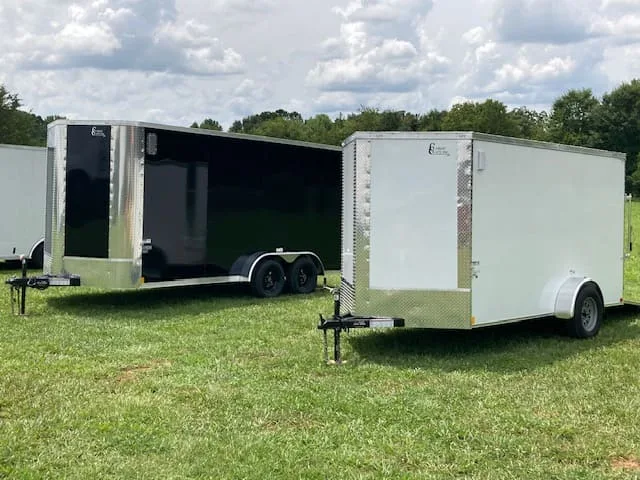
Choosing between a single or double axle trailer is an important step before making a purchase. Not only does this decision narrow down the overwhelming number of options, but it also ensures that your trailer meets your towing requirements. The number of axles on a trailer impacts load capacity, maneuverability, cost, and performance over long distances. In this article, we’ll cover the advantages and disadvantages of both single and double axle trailers, explore their various uses, and help you determine which one best suits your needs.
How do trailer axles work?
A trailer axle is the shaft that fits into the wheels to rotate them, help with braking, and balance the load. Since the axle transfers the weight from the trailer to the wheels, the number and type of axles determine how much weight the trailer can safely carry. If a load is heavier than an axle can support, the trailer may experience instability and swaying. With an additional axle, the weight distribution is shared, allowing the trailer to take on a higher load capacity. The most common types of trailer axles are leaf spring and torsion axles.
Leaf spring axles support the trailer using springs under or over the axle. They absorb shock from poor road conditions, offer a steady ride, and wear tires evenly. Although leaf spring axles are cheaper and easier to repair, they typically wear out more quickly than torsion axles due to metal-to-metal contact.
Torsion axles involve a tube encasing rubber cords that compress as the trailer wheels move to provide suspension. With fewer moving parts, torsion axles offer a smoother ride and less maintenance, but they are more expensive to replace. However, they do not distribute impact the way leaf spring axles do, so the wheels receive more impact if you hit something.
What is a single axle trailer?
A single axle trailer has one axle that connects one set of wheels. Single axle trailers are smaller than double axle trailers, making them lightweight and easy to tow. While their smaller size limits the amount of weight they can carry, single axle trailers can be used to tow a wide variety of cargo.
Pros of a single axle trailer
Single axle trailers are versatile, affordable, and available in several configurations, making them a great choice for towing lighter cargo. Here are a few advantages of hauling with a single axle trailer:
- Affordable: Single axle trailers typically cost less than double axle trailers.
- Fuel-efficient: Because they’re lightweight, single axle trailers allow for more fuel-efficient travel.
- Less maintenance: Single axle trailers have fewer parts to upkeep and replace and weigh less, contributing to less wear and tear.
- Maneuverability: Single axle trailers are easier to park and navigate in tight spaces because they’re smaller in size.
- Quick braking: With less weight to stop, single axle trailers can brake more quickly than double axle trailers.
Cons of a single axle trailer
While single axle trailers have many advantages, there are a few ways they fall short of a double axle trailer’s capabilities. Here are some disadvantages of towing a single axle trailer:
- Lower load capacity: Single axle trailers cannot handle as much weight as double axle trailers.
- Wear on tires: Because there are only two tires, each takes on more weight, causing them to wear more quickly.
- No braking system: Some single axle trailers do not come with brakes, but most states don’t require independent braking systems unless the gross weight is more than 3,000 pounds.
- No suspension: Some single axle trailers do not have a suspension system, which may affect its stability.
Uses of a single axle trailer
Single axle trailers serve various private and commercial purposes and typically transport lighter cargo. They can be used to tow household items like appliances and furniture, small vehicles, landscaping equipment and materials, and building supplies.
What is a double axle trailer?
A double axle trailer, also known as a dual or tandem axle trailer, has two axles with two sets of wheels. One axle is placed directly behind the other, boosting stability and load capacity. Not only can double axle trailers carry more weight, but they are also more reliable for longer hauls.
Pros of a double axle trailer
Double axle trailers are known for providing more stability and carrying more weight than single axle trailers. Here are a few advantages of buying a double axle trailer:
- Higher load capacity: The biggest draw of a double axle trailer is that it can carry more weight than single axle trailers of the same size.
- Stability: Double axle trailers have better weight distribution, which means they are sturdier and experience less swaying than single axle trailers.
- Braking system: Because double axle trailers tow more weight, they’re made with brakes built in.
- Additional tires: Double axle trailers have four tires instead of two, which means the weight and wear is distributed among them. They wear more slowly, and in the case of a blowout, you may not need to use a jack to change the tire.
Cons of a double axle trailer
While double axle trailers can carry more weight, they come with some added costs and difficulties on the road. Here are some disadvantages of towing a double axle trailer:
- More expensive: Double axle trailers usually cost more than single axle trailers of the same size and type.
- Fuel consumption: Because they’re heavier and tow heavier cargo, they cause the tow vehicle to consume fuel more quickly.
- More maintenance: Two axles and two sets of tires require more maintenance. Most double axle trailers also have built-in brakes and suspension systems, which are additional components to maintain.
- Maneuverability: Double axle trailers are more difficult to park and maneuver through tight spaces because of their extra bulk.
- Higher tolls: Toll prices can be determined based on a vehicle’s weight and number of axles. Double axle trailers have an additional axle and weigh more, making tolls more expensive.
Uses of a double axle trailer
Double axle trailers are better suited for traveling long distances and ideal for towing heavier items. Most commonly, they’re used for commercial purposes to tow cargo such as industrial machinery, one or several vehicles, or heavy equipment.
Which is right for you?
Single and double axle trailers both have their own advantages, disadvantages, and uses. One is not better than the other, but one is better for your specific use case. When choosing between a single axle and double axle trailer, you should consider the type of cargo you plan to haul, how much it will weigh, where you’ll be pulling the trailer, and how much weight your tow vehicle can handle.
Additionally, decide how much you’re willing to spend. A double axle trailer costs more upfront, in maintenance, and in fuel. Single axle trailers cost less upfront, but you will need to replace the tires more frequently and you may need to purchase trailer brakes.
What will you be using the trailer for?
First, determine the type of cargo the trailer will haul to assess how much weight the trailer must be able to tow. Overloading a trailer can cause accidents or damage, so it’s important to know the payload capacity and tongue weight to decide whether an extra axle is required. If you’ll be towing heavy cargo or you think you may be in the future, you should purchase a double axle trailer. If you expect to carry only lighter loads, you can probably opt for a single axle trailer.
The type of cargo you plan to transport also determines the type of trailer you will need. If you’re towing large machinery, you may need a flatbed trailer to accommodate the cargo’s height. If you need a trailer for expensive landscaping equipment, an enclosed landscaping trailer can provide protection against theft.
Learn more: Motorcycle Trailer Buyer's Guide
What size trailer do you need?
Consider the dimensions of the cargo you’ll be hauling. Single and double axle trailers come in a variety of sizes, but double axle trailers are typically larger. As a general rule, larger trailers weigh and cost more and are more difficult to maneuver. Purchase the smallest trailer size that will still be able to accommodate your cargo.
Remember, whether you purchase a single or double axle trailer, different trailer sizes require different sized hitch balls. Ensure you have the correct hitch ball size before towing your trailer. If it does not fit properly, the trailer could detach while on the road.
Where will you be driving your trailer?
Determine whether you’ll be towing your trailer over long distances on highways or frequently navigating through tight spaces. Double axle trailers perform better on long distance hauls, while single axle trailers are easier to maneuver and park. Although the weight of the cargo is the primary factor in choosing between single and double axle trailers, considering your driving conditions can make towing a trailer much easier.
What are you towing the trailer with?
Tow vehicles have weight limits, just like trailers. While most vehicles can tow a single axle trailer, double axle trailers often require larger tow vehicles. To find out how much weight your tow vehicle can safely haul, check your owner’s manual for the gross combined weight rating (GCWR). This indicates the total weight the whole setup can safely carry and can be calculated by adding the weights of your tow vehicle, passengers, luggage, and loaded trailer. If the calculated gross combined weight is less than your tow vehicle’s GCWR, that trailer will work for you. If it exceeds the GCWR, you may need a different trailer size or a larger tow vehicle.
Learn more: Guide to Trailer Weights by Trailer Type
No matter what kind of trailer you need, Ken Feagin Truck & Trailer has a selection of single and double axle landscaping equipment and materials trailers, motorcycle and car trailers, cargo trailers, and more. If you’re shopping for a new trailer in Asheville or Greenville, SC, we’re right down the road in Campobello, SC. Come visit us, or give us a call–we’re always happy to help.
You might also like: