


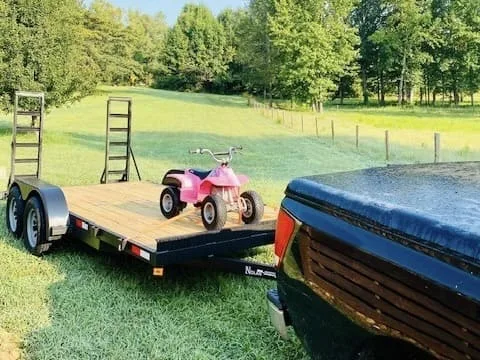
Flatbed trailers are easy to load and unload and can haul a variety of cargo–from cars to landscaping equipment. When it comes to purchasing a flatbed trailer, there are several different types and sizes available. To ensure optimal performance and safe hauling, it’s important to choose the flatbed trailer that best fits your hauling needs. In this guide, we’ll cover the types and sizes of flatbed trailers and how to decide which flatbed trailer is right for you or your business.
What is a flatbed trailer?
A flatbed trailer is an open deck trailer with no walls or roof, suitable for hauling cars and recreational vehicles, equipment, and, in the commercial hauling industry, oversized cargo. Depending on the model, a flatbed trailer may or may not have rails to help contain the cargo, but the deck is easy to reach, simplifying loading and unloading.
Not only is loading more flexible with a flatbed trailer, but its openness also increases capacity compared to enclosed trailers. Additionally, the simple design of a flatbed trailer allows for easy maintenance. However, flatbed trailers expose the cargo, and without the proper security measures, it could become damaged or stolen.
Flatbed trailer dimensions
Before purchasing a flatbed trailer, it’s important to determine what size you need based on the cargo you plan to haul. Each type of flatbed trailer comes in several different sizes to accommodate different hauling needs.
How long is a flatbed trailer?
Flatbed trailers can range from 12 to 53 feet long, depending on the type. Most small flatbed trailers are between 12 and 24 feet long, but flatbed trailers made for commercial hauling are much larger, from 48 to 53 feet long.
How wide is a flatbed trailer?
A flatbed trailer is typically between six feet and 8’6” wide. The maximum cargo width for a flatbed trailer is 8’6”, so flatbed trailers do not exceed this width.
How high is a flatbed trailer?
Most flatbed trailers sit between 1’11” and 2’2” above the ground. If your trailer sits low to the ground, be careful when going over bumps and other hazards in the road. Standard semi flatbed trailers are five feet high, but others are lower to allow for taller cargo.
4 types of flatbed trailers
Each type of flatbed trailer offers different weight capacities, sizes, and loading methods. In this section, we explore the four most common types of flatbed trailers and the benefits and uses for each.
1. Flatbed car hauler
A flatbed car hauler is a trailer with an open bed large enough to carry one or a few cars. They feature a ramp, making it easy to drive the cars onto and off of the trailer. These open car trailers are most often used when transporting cars to car shows or races or moving a car to a new location. Although flatbed car haulers offer less protection for the vehicle, they are more affordable and can hold just as much weight.
Learn more: Car Hauler Buying Guide: How to Choose the Best Car Trailer
2. ATV, UTV, or side-by-side trailer
ATV, UTV, or side-by-side trailers are made to transport one or multiple off-road vehicles or motorcycles. These trailers are typically smaller and lighter than car haulers, so they can be towed by vehicles with lower towing capacity. Like car haulers, ATV trailers have ramps for easy loading and unloading. They’re perfect for recreational vehicle owners who enjoy going on weekend adventures.
Learn more: How to Trailer Your UTV (Do's and Don'ts)
3. Flatbed equipment trailer
A flatbed equipment trailer is a versatile open trailer that can transport a variety of heavy equipment and materials. Flatbed equipment trailers are commonly used for landscaping, construction, and agriculture since they provide easy access to the tools and equipment inside. Open equipment trailers do not provide as much protection against theft as enclosed equipment trailers, but they are more affordable and much easier to load and unload.
Learn more: Which Trailer Is Best For Your Landscaping Business?
4. Semi flatbed trailer
A semi flatbed trailer is a commercial open deck trailer that hauls oversized, heavy, and unconventional cargo. Semi flatbed trailers can carry almost any type of cargo and are often used to transport construction equipment, building materials, oil rigs, vehicles, and wind turbines. There are several configurations and sizes for a variety of applications, making them a favorite in the commercial hauling industry.
Flatbed trailer sizes
Each type of flatbed trailer comes in several sizes to suit a variety of uses. We’ve outlined the most common dimensions for each one to help you decide which configuration best fits the cargo you need to carry.
| Trailer type | Deck length | Width | Height |
| Flatbed car hauler | 16’ to 24’ | 6’ to 8’ | 1’11” |
| ATV, UTV, SxS trailer | 12’ to 14’ | 6’ to 7’ | 2’2” |
| Flatbed equipment trailer | 20’ to 24’ | 7’ | 2’2” |
| Semi flatbed trailer | 48’ to 53’ | 8’6” | 5’ |
We offer flatbed car haulers, ATV, UTV, or side-by-side trailers, and equipment trailers in a variety of sizes. If you need help finding the perfect one for you, feel free to give us a call, and we’ll point you in the right direction.
How should you transport a load on a flatbed trailer?
Properly loading and securing cargo on a flatbed trailer is crucial. Follow these best practices to ensure the safety of yourself, your cargo, and others on the road.
- Use wheel chocks. Before you begin loading a flatbed trailer, chock the wheels to prevent the trailer from moving under the pressure of heavy equipment and other cargo. For the same reason, load the trailer in a flat area.
- Check the weight limits. Every trailer has a maximum cargo weight. Check your owner’s manual or ask the manufacturer for the Gross Vehicle Weight Rating (GVWR) to find out how much weight you can safely transport in your trailer.
- Load with proper weight distribution. When you load a flatbed trailer, start by loading the heaviest items. Then, add lighter items, distributing the weight evenly from side to side and front to back.
- Secure your cargo. Secure the load with straps or chains and tarps to make sure nothing will fly off as you drive.
- Inspect the trailer. Walk around the trailer, looking for potential issues. Once you’ve double checked that the cargo is secure, the trailer is functioning properly, and the trailer is hooked up correctly, you’re ready to go.
How much weight can a flatbed trailer carry?
While an ATV or motorcycle trailer can tow between 2,000 and 6,000 pounds, an equipment trailer can carry up to 15,000 pounds, depending on its size. A flatbed car hauler can carry between 7,000 and 9,900 pounds. Keep in mind that the combined weight of your trailer and its cargo must not exceed the GVWR, or maximum tow capacity, of your tow vehicle.
Learn more: Guide to Trailer Weights by Trailer Type
How to choose the right flatbed trailer for you
Between all the different types and the size options for each, there’s a lot to consider when choosing a flatbed trailer. Here are a few questions you can ask yourself to assess which flatbed trailer best meets your needs:
- How much weight do you need to transport? With a good idea of how much your cargo will weigh, you can eliminate any trailers that do not meet your tow weight requirements.
- What kind of cargo do you plan to haul? Ensure the trailer you choose will be easy to load and fit the cargo you plan to haul. If you’ll be towing valuable equipment that is not easy to secure on an open bed, an enclosed trailer may better suit your needs.
- What is your budget? Pricing varies depending on what type and size of trailer you intend to purchase. If you’re looking to finance a trailer, Ken Feagin Truck & Trailer offers several financing options.
If you’re shopping for a flatbed trailer in Asheville or Greenville, SC, we’re right down the road in Campobello, SC. Come visit us, or give us a call–we’re always happy to help.
You might also like: