


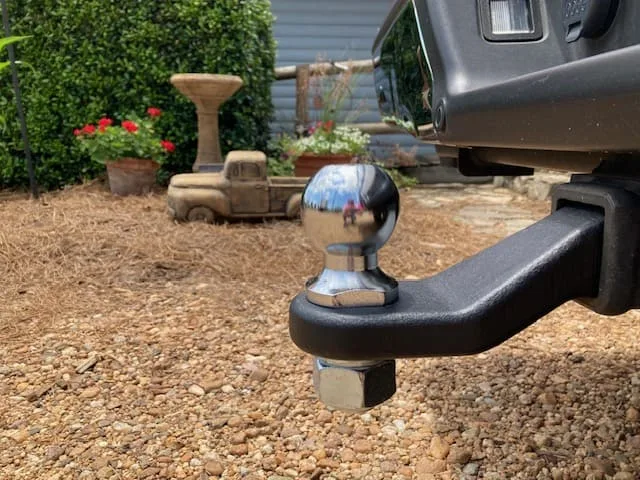
Trailer ball hitches come in varying size options with different weight ratings. Choosing the right size hitch is extremely important to ensure you can safely tow the load you want to carry. If you don’t have the correct size hitch, your towing vehicle and trailer won’t be level, and you might carry an unsafe amount of weight.
In this guide, we’ll break down the most common tow hitch ball sizes so you can understand which size is best for you. We’ll also show you how to measure your trailer to determine what size trailer hitch you need.
What is a hitch ball?
A hitch ball is the piece that connects a trailer to its hitch. You might also hear this part of the towing system called a trailer ball or tow ball. As you might expect, it’s shaped like a ball — which allows the trailer to pivot and turn — and fits into a piece called the hitch pin. The hitch pin attaches to the tow vehicle’s trailer hitch and the trailer’s coupler.
The hitch ball connects the pieces that must come together for the tow vehicle and trailer to connect securely. It allows the vehicle and trailer to move together, so you can drive your truck forward while pulling the trailer or smoothly turning around a corner with the trailer attached.
Trailer ball sizes are usually standard across the board. However, you’ll find that other elements of the hitch ball (such as hitch ball weight ratings) can differ. The size of your trailer ball hitch will affect how much weight you can safely tow.
You may also like: Types of Trailer Hitches Explained
What is a ball mount?
The ball mount is the part of the hitch system that raises or lowers the hitch ball. This keeps your tow vehicle and trailer level. The ball mount is essential for safety and stability as you tow.
A fixed ball mount offers a permanent connection between the trailer and the vehicle, ensuring high security and stability. Once installed, it cannot be adjusted, making it ideal for towing a specific trailer whose coupler height matches the tow vehicle. In contrast, an adjustable ball mount provides the flexibility to be modified to different heights, accommodating various trailers regardless of their coupler height. This adaptability makes it a versatile choice for those who tow multiple types of trailers.
Standard trailer ball sizes
The standard trailer hitch ball sizes are 1⅞ inches, 2 inches, 2 5/16 inches, and 3 inches. A larger hitch can carry larger, heavier loads.
1⅞-inch trailer ball
This is one of the most common trailer ball sizes you’ll find. It’s best for lightweight trailers with smaller loads. The weight limit for a 1⅞ inch trailer hitch typically tops out at 3,500 lbs.
2-inch trailer ball
With a 2-inch trailer ball, you can carry up to 12,000 lbs. This size trailer hitch is for medium-sized trailers with larger cargo loads.
2 5/16-inch trailer ball
Next on the list of standard ball hitch sizes is the 2 5/16 inch trailer hitch. We recommend this size hitch for heavier trailers carrying loads such as livestock or larger boats. Most trailer hitches this size have a maximum weight capacity of 30,000 lbs.
3-inch trailer ball
A 3-inch trailer hitch is a good fit for gooseneck trailers or commercial vehicles with heavy industrial equipment.
Tow ball weight ratings
Each size trailer hitch has a weight rating. This describes the maximum weight you can tow when using that size hitch ball. Exceeding a trailer ball’s weight rating can be dangerous. Before purchasing a trailer hitch, make sure to check its weight capacity.
Gross Trailer Weight (GTW) is the total weight of the trailer plus its cargo, and it is crucial to consider when selecting a hitch ball. The GTW must align with the weight rating of the hitch ball to ensure safe towing. Each hitch ball is rated not only for maximum tow ball weight, which is the downward force on the hitch but also for the total GTW it can safely handle. To prevent accidents or damage to your vehicle, verify that the GTW of your intended load does not exceed the hitch ball’s rated capacity.
You may also like: How to Load a Trailer with Proper Weight Distribution
Measuring for your trailer hitch
Measuring your trailer can help you determine what size hitch is best for you. You can do this by measuring the coupler on your trailer. If needed, you can also measure the size of your current trailer ball hitch. We recommend keeping a few different hitch sizes on hand in case you need to adjust for different trailer sizes or larger loads. To figure out what size trailer hitch you need, follow these steps.
1. Find your hitch height
First, measure the height of your trailer hitch. Park your tow vehicle on level ground. Use a measuring tape from the top of the hitch receiver opening to the ground.
2. Find your coupler height
The next step is finding your coupler height. Make sure your trailer is level. Then, measure from the ground to the bottom of the coupler.
3. Measure the difference
Finally, subtract the height of the trailer coupler from the height of the hitch receiver:
Hitch height – coupler height = amount of drop needed in a ball mount
When aligning your tow vehicle with the trailer, the relative heights of the hitch and the trailer's coupler are crucial. If the hitch height on your vehicle is greater than the coupler height of the trailer, you will need a ball mount with a 'drop.' This type of ball mount extends downward from the hitch, bringing the hitch ball to an appropriate level below the receiver to match the trailer’s coupler. The 'drop length' refers to the vertical distance the ball mount lowers the hitch ball below the hitch’s receiver opening.
Conversely, if the trailer's coupler height is higher than the vehicle's hitch height, a ball mount with a 'rise' is necessary. This configuration involves a ball mount that extends upward, elevating the hitch ball above the receiver to meet the higher coupler. The 'rise length' is the vertical distance by which the hitch ball is raised above the receiver opening.
Selecting the correct drop or rise ensures that the trailer is level with your vehicle, enhancing stability and safety while towing.
Finding the correct trailer hitch ball size
Choosing the right hitch ball size is vital for a secure and stable towing experience—this isn't the place to compromise on accuracy. Follow these essential tips to guarantee you're on the right track:
- Measure accurately: Use a reliable measuring tape to determine the coupler size of your trailer. This measurement will directly correspond to the diameter of the hitch ball you need.
- Check your vehicle’s manual: Refer to your vehicle's owner manual for recommendations or restrictions on hitch ball sizes.
- Assess towing capacity: Ensure that the hitch ball size matches not just the coupler, but also your vehicle's towing capacity. Overloading can lead to serious accidents.
- Verify weight ratings: Each ball size has a maximum weight capacity. Verify that the ball's weight capacity meets or exceeds the gross trailer weight (GTW).
- Use the right tools: When installing the hitch ball, use the appropriate tools to ensure it is tightened to the manufacturer's specified torque.
- Regular inspection: Check the hitch ball regularly for wear and tear, corrosion, or damage. Replace it if necessary to maintain safety.
- Consult professionals: If you are unsure, consult a professional for advice on the appropriate hitch ball size and installation methods.
If you’re shopping for a new or used trailer in Asheville or Greenville, SC, we’re right down the road in Campobello, SC. Come visit us, or give us a call–we’re always happy to help.
You may also like: