


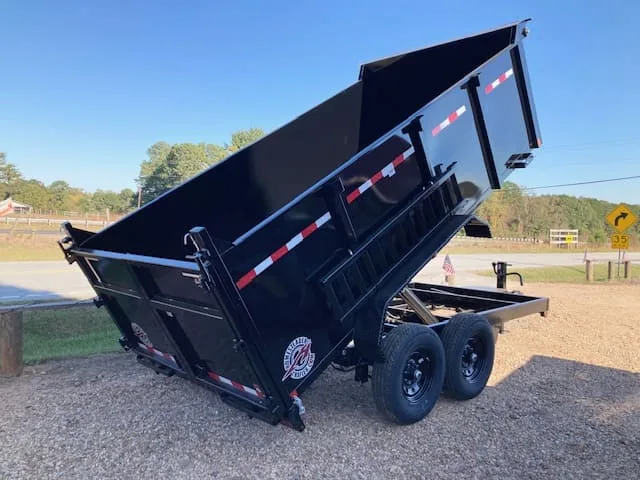
A dump trailer that's too small means extra trips, wasted fuel, and jobs that take longer than they should. One that's too big costs more upfront, requires a heavier tow vehicle, and can be a hassle to maneuver and store.
Choosing the right dump trailer depends on what you're hauling, how heavy it is, and how often you'll use it. A homeowner clearing brush a few times a year has very different requirements than a contractor hauling gravel five days a week.
This guide breaks down common dump trailer sizes, explains why payload capacity often matters more than bed dimensions, and walks through the key factors that affect your decision.
What size dump trailer do you need?
Dump trailer sizes range from compact models designed for occasional homeowner use to heavy-duty trailers built for commercial hauling. Most buyers fall into one of three categories: 5x8 and 5x10 trailers for residential projects, 6x10 and 6x12 trailers for landscaping and property maintenance, and 7x12 through 7x16 trailers for construction and heavier commercial work.
Dump trailer sizes are based on the inside bed dimensions. These measurements determine how much usable floor space you have for materials, equipment, and debris. The chart below shows what projects each trailer size is typically used for.
| Trailer Size | Best For | Typical Users |
| 5x8 / 5x10 | Yard cleanup, mulch, small DIY projects | Homeowners |
| 6x10 / 6x12 | Landscaping, property maintenance, topsoil | Landscapers, small contractors |
| 7x12 / 7x14 | Construction debris, gravel, compact equipment | Contractors, remodelers |
| 7x16 | Heavy commercial hauling, demolition, excavation | Construction crews, excavators |
5x8 and 5x10 dump trailers
A 5x8 or 5x10 dump trailer is among the smallest dump trailers commonly available, and it's built for occasional use. The single-axle frame makes maneuvering easy in tight spaces like driveways and backyards.
For homeowners, this size handles yard waste, mulch deliveries, and small renovation cleanups. Most 5x8 and 5x10 trailers can be towed by a properly equipped half-ton truck or large SUV, which keeps the barrier to entry low.
6x10 and 6x12 dump trailers
For many buyers, a 6x10 or 6x12 hits the sweet spot. This size handles most landscaping and property maintenance jobs without being oversized for the work.
You'll find both single and tandem axle configurations in this range. Tandem axles add stability and increase payload capacity, which matters if you're hauling denser materials like topsoil or gravel on a regular basis. Landscapers and small contractors often start here because the balance between capacity and maneuverability works well for everyday jobs.
7x12 and 7x14 dump trailers
Once you move into 7-foot-wide trailers, you're looking at serious work capacity. A 7x14 is one of the most popular sizes for contractors handling roofing tear-offs, concrete removal, and compact equipment.
Most 7x12 and 7x14 trailers feature tandem axles with 7,000-pound ratings each, giving you a 14,000-pound GVWR. That's enough to load compact equipment like a mini skid steer or haul several tons of aggregate in a single trip. But if you routinely haul even larger loads or transport heavy equipment, stepping up to a 7x16 may make more sense.
7x16 dump trailers
A 7x16 is built for high-volume commercial work, like demolition, excavation, and heavy equipment transport. With 14,000 to 16,000-pound GVWRs, a 7x16 can handle the densest materials and largest loads.
Whether or not a 7x16 is too big depends entirely on your typical workload and tow vehicle. If you're running a busy excavation crew, it's probably right-sized. If you're a remodeler hauling debris a few times a week, you might find a 7x14 easier to maneuver and store without sacrificing much capacity.
GVWR and payload capacity matter more than size alone
Two dump trailers with identical bed dimensions can have very different hauling capacities. The difference comes down to GVWR, which stands for gross vehicle weight rating.
GVWR is the maximum total weight the trailer can safely carry, including the weight of the trailer itself. If a trailer has a 10,000-pound GVWR and weighs 2,500 pounds empty, your actual payload capacity is 7,500 pounds. Go over that limit, and you risk damaging the trailer, overloading your tow vehicle, and creating unsafe conditions on the road.
GVWR matters because dense materials like gravel, wet soil, and concrete often hit the weight limit long before they fill the bed. A 6x12 trailer might look half-empty but already be at capacity if you're hauling crushed stone.
| Trailer Size | Typical GVWR | Approximate Payload | Best For |
| 5x8–5x10 | 5,000–7,000 lbs | 3,000–5,000 lbs | Light residential |
| 6x10–6x12 | 7,000–10,000 lbs | 5,000–7,500 lbs | Landscaping |
| 7x14 | 12,000–14,000 lbs | 9,000–11,000 lbs | Construction |
| 7x16 | 14,000–16,000 lbs | 10,000–12,000 lbs | Heavy commercial |
Pro tip: Always calculate payload capacity before buying. Subtract the trailer's empty weight from its GVWR to know exactly how much material you can legally and safely haul.
Make sure your tow vehicle can handle it
Your truck's tow rating determines what size dump trailer you can safely pull. The tow rating represents the maximum weight your vehicle can handle, not just the empty trailer, but the trailer fully loaded.
A common mistake is matching a truck's tow rating to the trailer's empty weight. If your truck is rated for 10,000 pounds and you buy a trailer with a 10,000-pound GVWR, you're already at the limit before adding any cargo.
Half-ton trucks
Half-ton pickups like the Ford F-150, Chevy Silverado 1500, and Ram 1500 typically tow between 9,000 and 13,000 pounds depending on configuration. A half-ton pairs well with smaller dump trailers in the 5x8 to 6x12 range with GVWRs under 10,000 pounds.
What size dump trailer can a 1500 pull? For most half-tons, a 6x10 or 6x12 with a 7,000 to 9,000-pound GVWR is a comfortable match. Going larger is possible with some configurations, but you'll be working closer to your truck's limits.
Three-quarter-ton trucks
Trucks like the F-250, Silverado 2500, and Ram 2500 handle 12,000 to 20,000 pounds depending on engine and axle ratio. A three-quarter-ton is better suited for regular hauling with 7x12 and 7x14 dump trailers.
One-ton trucks
For 7x16 trailers and heavy commercial work, a one-ton truck (F-350, Silverado 3500, Ram 3500) provides the stability, braking power, and payload capacity to handle fully loaded trailers day after day.
Side wall height affects capacity
The bed dimensions of a dump trailer tell you floor space, but wall height determines volume. A 6x12 trailer with 24-inch sides holds significantly less material than the same trailer with 48-inch sides.
- 24-inch sides: Easier loading, better for dense materials and equipment
- 32-inch sides: Good middle ground for mixed use
- 36-inch sides: Popular for landscaping materials
- 48-inch sides: Maximum volume for bulky, lightweight materials
Taller sides work well for brush, leaves, mulch, and firewood, materials that are bulky but relatively light. Shorter sides make sense for gravel, dirt, and equipment loading where you're more likely to hit weight limits before filling the bed.
Some trailers offer removable side extensions, which give you flexibility to adjust capacity based on the job.
Low-profile vs. deckover dump trailers
Beyond wall height, dump trailers come in two basic configurations: low-profile and deckover.
Low-profile trailers sit closer to the ground, making it easier to load equipment with a ramp or by hand. Contractors who haul compact equipment, pallets, and dense materials often prefer low-profile designs because volume isn't the priority—weight capacity is.
Deckover trailers maximize cubic yard capacity for lighter, bulkier loads. This configuration sometimes includes a drop-down side wall allowing the trailer to be loaded from the side.
Bumper pull vs. gooseneck
Most dump trailers are bumper pull, meaning they connect to a standard ball hitch on your truck's rear bumper. A bumper pull setup works well for trailers up to about 14,000 pounds GVWR and keeps things simple for most users.
Gooseneck dump trailers connect to a hitch in the truck bed, which improves stability and weight distribution for heavier loads. Goosenecks are typically reserved for larger commercial trailers and require a compatible hitch setup in your truck bed.
For most contractors and landscapers, a bumper pull dump trailer handles the job. Goosenecks make sense when you're regularly hauling at the upper end of the weight spectrum.
Common dump trailer sizing mistakes
Buying the wrong size dump trailer usually comes down to a few predictable errors:
- Focusing only on bed dimensions: A 7x14 with a 10,000-pound GVWR hauls less than a 6x12 with a 14,000-pound GVWR
- Ignoring tow vehicle limits: Your trailer's GVWR can't exceed what your truck can safely pull
- Buying too small to save money: Undersized trailers mean more trips, more fuel, and more wear on your equipment
- Buying too large "just in case": Oversized trailers cost more, require bigger trucks, and are harder to store and maneuver
- Forgetting about storage and access: A 7x16 trailer doesn't fit everywhere a 6x10 does
The best approach is buying for the work you'll do most often, not the occasional outlier job.
Towing regulations to keep in mind
Trailer brakes are required in most states for trailers over a certain weight, typically 3,000 pounds GVWR, though this varies by state. Dump trailers in the 6x10 and larger range almost always require electric brakes and a brake controller in your tow vehicle.
Width limits, load securement requirements, and tarp laws also vary by state. Some jurisdictions require tarps over loose materials on public roads.
If your combined vehicle weight (truck plus loaded trailer) exceeds 26,000 pounds, you may need a commercial driver's license depending on your state's regulations. Verify the rules in your area before committing to a larger trailer.
Find the right dump trailer at Ken Feagin Truck & Trailer
We stock dump trailers from Homesteader, Hawke, and Sure-Trac in sizes from 6x10 through 7x16. Whether you're a landscaper looking for a reliable 6x12 or a contractor who needs a heavy-duty 7x14 with a telescopic hoist, we can help you compare options and match the right trailer to your tow vehicle.
If you'd like help figuring out which size, GVWR, and configuration fits your work, come on by or give us a call. We're located in Campobello, SC, right off exit 5 on I-26.
You may also like: