


Electric trailer brakes can make the difference between a smooth, steady stop and a white-knuckle ride down a hill. If you tow regularly, getting your brake controller and gain settings dialed in is necessary for legal towing, safety, and protecting your truck’s brakes from unnecessary wear.
Adjusting your electric trailer brakes is simple once you understand how they work. Whether you’re hauling equipment, livestock, or materials for the job site, this guide breaks down what electric trailer brakes do, how to test them, and how to fine-tune your setup for confident, controlled towing every time you hit the road.
Skip to step-by-step instructions ↓
What are electric trailer brakes?
Electric trailer brakes are a braking system that uses electrical signals from your tow vehicle to control your trailer’s brakes. They activate at the same time as your vehicle’s brakes but operate independently, giving you smoother, more even stopping power. This setup reduces strain on your vehicle’s braking system and helps you maintain better control and prevent trailer sway, especially when hauling heavy loads. They offer consistent braking performance, improve safety, and extend the life of your tow vehicle’s brakes.
How do electric trailer brakes work?
Electric trailer brakes activate when they receive an electrical signal from the brake controller in your tow vehicle. When you press the brake pedal, the controller sends the current through a wire to an electromagnet inside each brake drum.
As voltage is applied, the magnet is pulled against the inside of the drum, which in turn pushes the brake shoes outward against the drum surface. The harder you press the brake (or the higher you set the gain on your controller), the more voltage is sent to the magnet, increasing braking force.
When are electric brakes required on a trailer?
In most states, electric trailer brakes are legally required for trailers weighing over 3,000 pounds, loaded or unloaded.
Unique electric trailer break requirements:
- Massachusetts requires brakes on trailers over 10,000 lbs.
- Alaska requires brakes on trailers over 5,000 lbs.
- Texas requires brakes on trailers over 4,500 lbs.
- Delaware, North Carolina, and Rhode Island require brakes on trailers over 4,000 lbs.
How do I know if my trailer has electric brakes?
You can tell if your trailer has electric brakes by checking for brake wiring and hardware near the wheels.
What to look for:
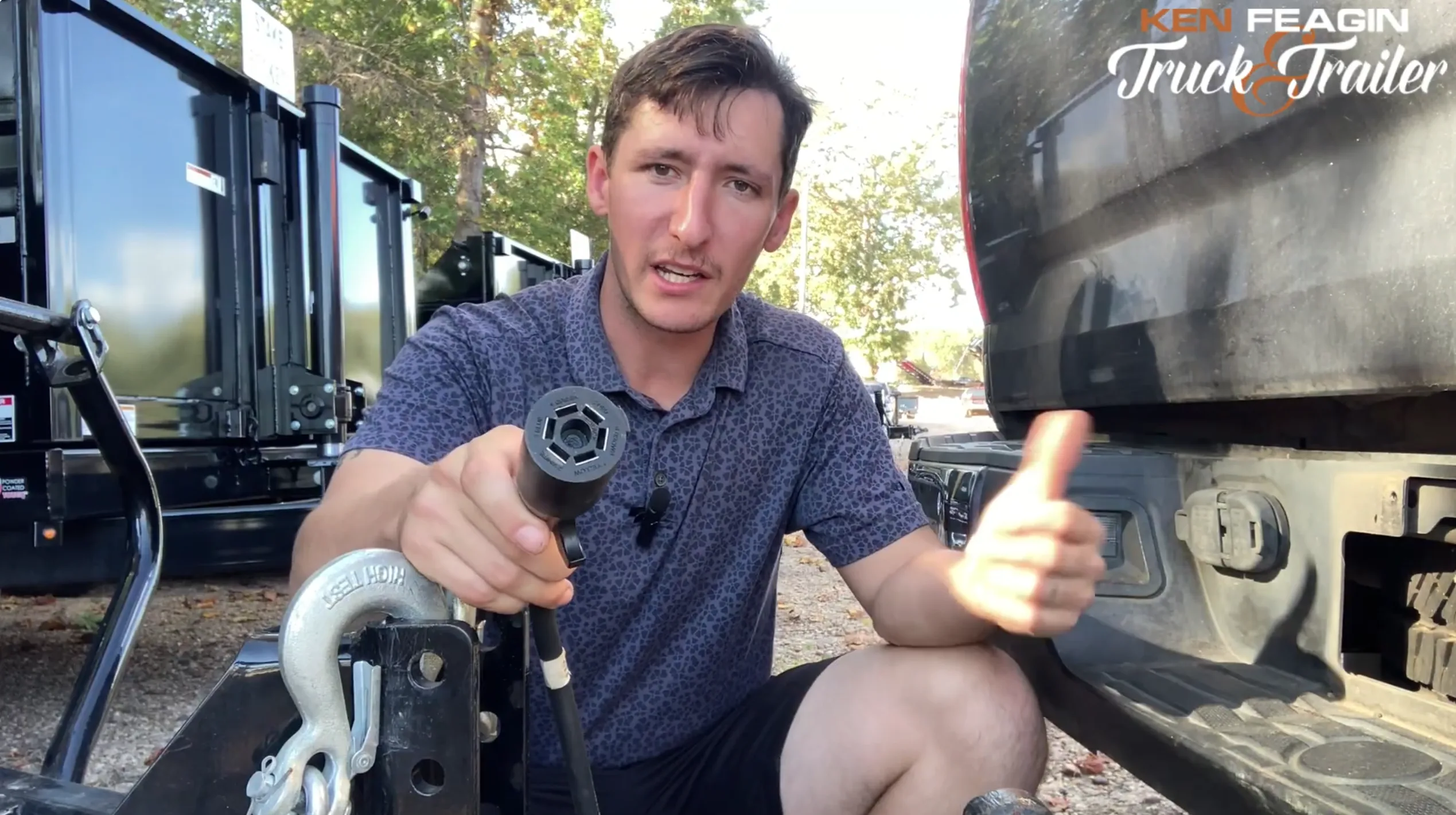
- A 7-pin round connector near the trailer hitch for trailer brakes and lights.
- Brake wires running into the back of each wheel hub.
- Brake backing plates or drums mounted behind the wheels.
If your trailer has a 7-pin plug, wires running to the back of the wheel hubs, and brake assemblies with discs behind the wheels, it has electric brakes. If your setup only has a 4-flat plug or if the hubs are bare with no wires or backing plates, your trailer doesn’t have electric brakes.
Learn more: What Equipment Is Required on a Trailer? Everything You Need for Legal & Safe Towing
What is an electric brake controller?
An electric brake controller is a small device in the cab of your towing vehicle that lets you control how much braking power is sent to the trailer’s electric brakes. When you press the brake pedal, the controller sends the set amount of voltage to the trailer to engage the trailer’s brakes. Brake controllers can be factory-integrated or installed after-market if your vehicle doesn’t already have one.
Most controllers have two parts:
- Manual lever: Lets you apply the trailer brakes on their own without pressing the vehicle’s brakes, which is a useful feature for testing the brakes or controlling sway.
- Gain controls: +/- buttons or a dial that adjust how much braking power is sent to the trailer.
Where to find your electric brake controller
You can usually find the electric brake controller below or to the side of the steering wheel, often near your trailer light controls or tow/haul switch.
- Ford: built into the dash with a small digital display and +/– buttons.
- Chevy/GMC: on the left side of the dash or integrated into the driver information screen.
- Ram: below the climate controls with a small slider and gain display.
- Toyota or aftermarket units: often mounted under the dash or on the center console.
Brake controllers typically have two main adjustments: delay and gain. The delay setting controls how quickly the trailer brakes engage after you press the tow vehicle’s brake pedal, while the gain controls how much power is sent to the trailer’s brake magnets.
What is trailer brake gain?
Trailer brake gain is the power setting controlling your trailer’s brakes when you press your brake pedal. It’s measured as a voltage output between 0.0 and 10.0 from your brake controller to the trailer: the higher the gain, the harder the trailer’s brakes engage. Heavier trailers need more braking power to stop safely, while lighter or empty trailers need less to avoid skidding or wheel lockup.
Other factors can also change your ideal gain setting, including:
- Load weight and distribution: More weight or a tongue-heavy load requires higher gain.
- Road surface: Wet, gravel, or icy roads need a lower gain setting to prevent sliding.
- Brake wear: Older or worn brake shoes may need slightly higher gain to achieve the same stopping power.
- Trailer type: Dual-axle or heavier-duty setups often respond differently than small single-axle trailers.
Brake gain isn’t a set-it-and-forget-it number. It should be changed according to your trailer’s load and the conditions you’re driving in. Any time you change what you’re hauling, shift weight in the trailer, or face different terrain, fine-tune the gain before hitting the road. That quick adjustment keeps your braking smooth and balanced between the tow vehicle and trailer.
How to adjust electric trailer brakes
Once you understand how your electric brakes and controller work, setting them correctly is straightforward. These steps walk you through connecting, testing, and fine-tuning your trailer’s braking so it responds evenly with your tow vehicle.
Step 1: Plug in your electric brake controller
Before adjusting anything, make sure the trailer is properly connected to the tow vehicle. Push the 7-way plug firmly into the vehicle socket until it locks or clicks in place.
- Inspect both sides for corrosion, dirt, or bent pins. Even a small amount of buildup can weaken your brake signal.
- Confirm that the ground wire on the trailer frame is tight, clean, and free of rust. A weak ground or damaged wire can cause flickering on the controller display or intermittent braking.
- If your controller reads “No Trailer Connected,” fix the wiring issue before adjusting the gain.
Pro tip: Apply a light dab of dielectric grease to the plug to keep moisture out and ensure a clean connection.
Step 2: Adjust trailer brake gain
To adjust your trailer brake gain, follow these steps:
- Place your vehicle in “tow haul” mode.
- Set your trailer brake gain to a mid-level 3.0 or 4.0, which is standard for an empty trailer. The number is displayed on the controller or on your dashboard.
- Start driving about 20 mph.
- Pay attention to how the trailer reacts when you brake.
- The gain is too high if the trailer tugs sharply or locks up, dragging behind the vehicle.
- The gain is too low if the trailer pushes against the vehicle or doesn’t slow at the same speed.
Repeat your adjustments until the trailer slows with your towing vehicle firmly but smoothly, and without jerking or dragging.
Step 3: Test at higher speeds
Repeat test stops at 30 and 40 mph to be sure the trailer and tow vehicle brake together evenly. The goal is one smooth stop for both the tow vehicle and the trailer, not a push-and-pull effect. Repeat until the trailer slows you firmly but smoothly, without jerking or dragging.
Step 4: Recheck whenever conditions change
Brake gain isn’t a one-time adjustment. Your ideal setting varies with load weight, road surface, brake wear, and even weather.
- Heavier loads or steep downhill grades = slightly higher gain
- Empty trailers or slick surfaces = slightly lower gain
- Uneven or unpredictable response = check brake wear or wiring
Taking a minute to fine-tune your gain before each haul keeps your trailer braking balanced, prevents tire wear, and protects your tow vehicle’s brakes. If you switch trailers often, jot down the gain number that feels right for each setup. It’ll save time the next time you hitch up.
Learn more: 7 Signs It's Time to Replace Your Trailer Brakes
Find expert trailer advice at Ken Feagin Truck & Trailer
Whether you’re comparing dump trailers, figuring out lighting requirements, or learning how your brake setup works, our team at Ken Feagin Truck & Trailer knows trailers inside and out. Count on us for real, experience-backed advice to help you haul safely and choose the trailer that fits your work.
Please come by or give us a call—we’re happy to answer your questions and help you find exactly what you need. Whether you’re coming from Asheville, Hendersonville, Spartanburg, or Greenville, SC, we’re located right down the road in Campobello, SC, off of exit 5 on I-26.
You might also like: