


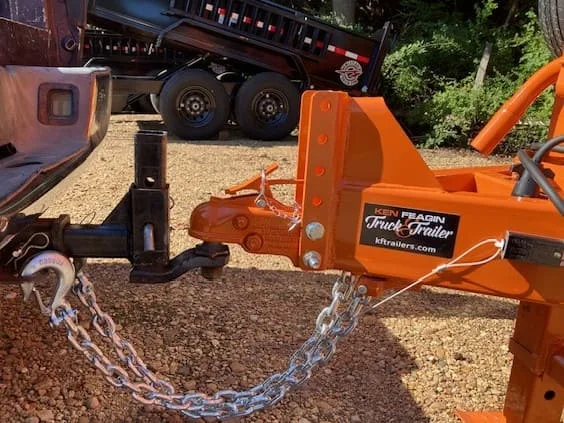
Trailer safety starts before you ever hit the road. The way you load your trailer directly impacts how it will tow, and tongue weight is a crucial measurement of how well your trailer is loaded. With too much or too little tongue weight, the trailer may sway, or the you could lose control of the vehicle. In this article, we’ll explain what tongue weight is, why it’s important, and how to measure it.
What is tongue weight?
Tongue weight is the downward force the trailer tongue, or the front part of a trailer, exerts on the hitch ball of the tow vehicle. When the trailer tongue is hitched for towing, it serves to balance the load weight over the hitch and keep the trailer upright. Too much or too little force from the tongue can create an imbalance, transferring weight to the back of the tow vehicle or causing the trailer to sway. An acceptable tongue weight is important for safe towing, and when neglected, can lead to dangerous towing conditions.
Hitch weight vs. tongue weight
If tongue weight is the amount of force bearing down on the hitch, hitch weight is the amount of force the hitch receives from the tongue. In other words, hitch weight and tongue weight will always be the same number. The two terms are used interchangeably since they refer to the same measurement.
Why understanding tongue weight is important for towing
Towing with a tongue weight outside the acceptable range is dangerous for you, your vehicle, and others on the road. If you’ve ever seen or experienced trailer sway or an unlevel hitch, it’s likely this was caused by too much or too little tongue weight. With excessive tongue weight, handling is impaired, and with inadequate tongue weight, the trailer sways. Either situation causes the driver to lose control of the vehicle, becoming more and more dangerous as the vehicle gains speed. Trailer sway can eventually cause the trailer to tip over or disconnect from the tow vehicle.
How tongue weight affects your vehicle
When hooked up, the trailer behaves like a lever, pivoting from its axle. If the trailer load is unbalanced, the tongue applies too much or too little force to the hitch, causing the back end of the tow vehicle to lift up or sink down. Not only can this cause trailer sway, but it can affect the vehicle’s handling.
When the tongue weight is too heavy, your vehicle may suffer from:
- Less traction
- Accelerated wear on the rear tires
- Tire blowouts
- Stress on the rear axle
- Unresponsive braking and steering
- Reduced fuel efficiency
These conditions can damage or cause you to lose control of your vehicle, which may result in an accident. To avoid risking the safety of yourself and others, measure tongue weight before towing to ensure it is within the acceptable range.
What is a good tongue weight?
A good tongue weight for a bumper pull trailer is between 9 and 15 percent of the loaded trailer’s weight. Since gooseneck trailers can carry heavier loads, they should have a tongue weight of 15 to 30 percent of the loaded trailer’s weight.
Learn more: Bumper Pull vs. Gooseneck: Which Style Trailer Is Right for You?
To find the acceptable range for your trailer, add your trailer and load weights, then take the minimum and maximum tongue weight percentages of that total. For example, an acceptable tongue weight range for a gooseneck trailer that weighs 3,000 pounds and is carrying 4,000 pounds is 1,050 to 2,100 pounds, 15 to 30 percent of the gross trailer weight of 7,000 pounds.
Tongue weight vs. trailer weight
Trailer weight refers to how much a trailer weighs before it’s loaded, and gross trailer weight is the trailer’s total weight after it’s loaded. Tongue weight is the amount of force from the loaded trailer applied to the hitch ball through the trailer tongue. While the gross trailer weight is the same no matter how the trailer is loaded, the tongue weight can change drastically depending on how the load weight is distributed. However, similar to tongue weight, every trailer has a maximum load weight that causes safety issues when exceeded.
Learn more: Guide to Trailer Weights by Trailer Type
How to measure tongue weight
Because an acceptable tongue weight is key to safe towing, you should measure tongue weight each time you tow. There are several methods for measuring tongue weight, so choose the one that’s most convenient for you. Here are three different ways to measure tongue weight:
1. With a drive-on scale
If you have access to a drive-on scale, you can use it to find tongue weight with some quick math. Drive onto the scale before hooking up the trailer to find the tow vehicle’s weight. Then, connect the trailer, and drive onto the scale again, keeping the trailer tires off of the scale. This will give you the combined weight of the tow vehicle and the tongue weight. To isolate the tongue weight, simply subtract the tow vehicle’s weight from the combined weight.
2. With a bathroom scale
If your trailer is small enough, you may be able to use a bathroom scale to measure tongue weight. To do this, raise the scale to the height of the vehicle’s hitch ball with something sturdy like a cinder block or wooden beam. Next, place the trailer tongue on top of the elevated bathroom scale to find the tongue weight.
3. With a tongue weight scale
If you tow your trailer often, it may be worth investing in a tongue weight scale. This is the easiest option, and since it’s made especially for measuring tongue weight, it’s the most accurate as well. Some of these scales are designed like a trailer jack so that the trailer’s ball mount rests on the top of the scale. Others are built into a trailer hitch and automatically calculate tongue weight when the trailer is hooked up.
How to adjust tongue weight
If you measure the tongue weight and find it’s outside of the acceptable range, you need to adjust it. But don’t sweat it–this is very easy to do. Tongue weight can be adjusted by rearranging the load. If the tongue weight is too light, simply move the load slightly forward. If the tongue weight is too heavy, move the load slightly backward. Make sure the load is balanced across the width of the trailer as well. You should continue adjusting the load until you reach an acceptable tongue weight.
When you load a trailer, about 60 percent of the total load weight should be placed in front of the trailer’s axle. The remaining 40 percent should be placed behind the trailer’s axle. If you load your trailer this way to start, you will most likely not need to adjust the tongue weight.
At Ken Feagin Truck & Trailer, your safety is our priority. If you have questions about tongue weight or you’re shopping for a trailer in Asheville or Greenville, SC, we’re right down the road in Campobello, SC. Come visit us or give us a call–we’re always happy to help.
You might also like: