


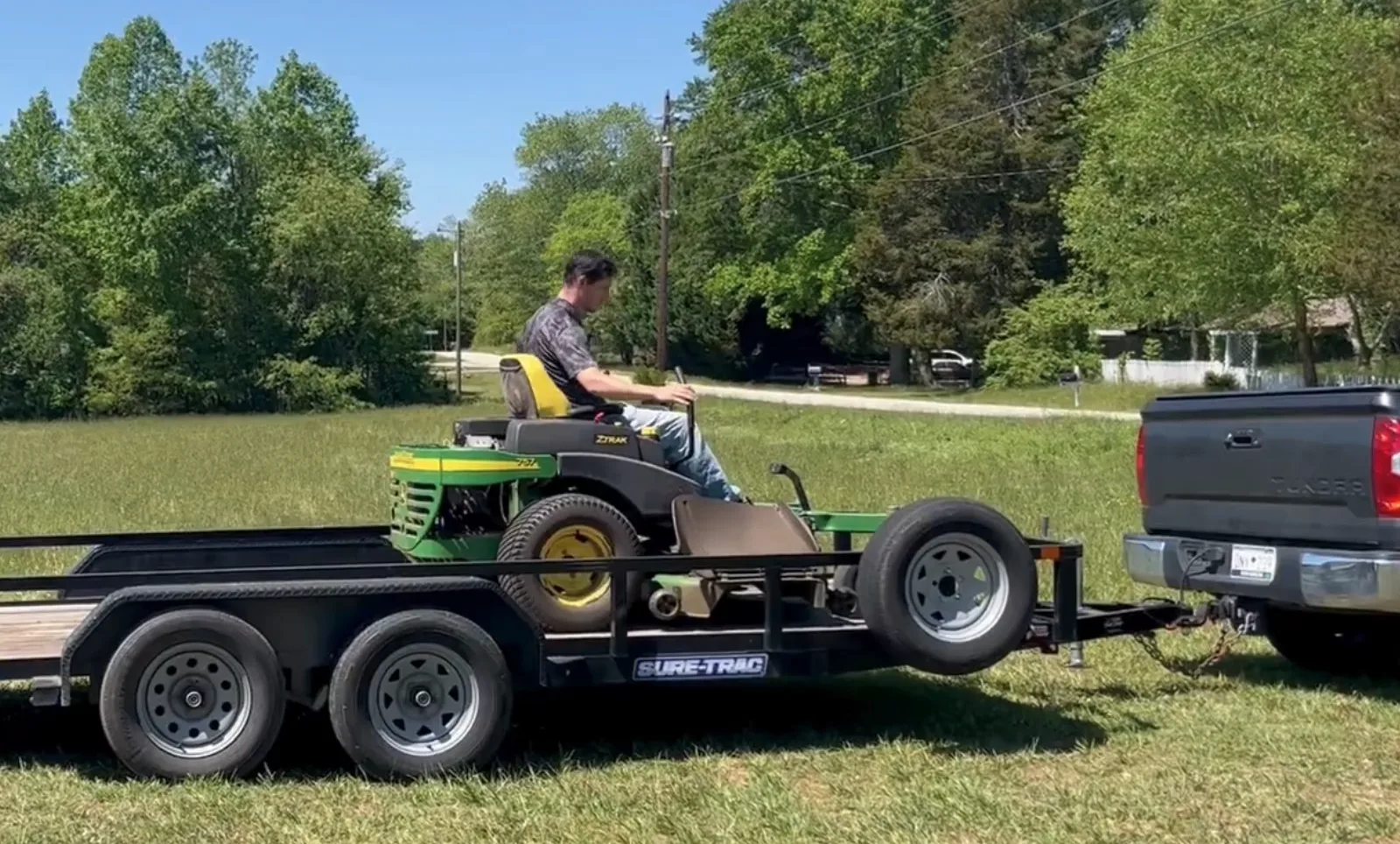
A mower that shifts mid-transport can roll off the trailer, damage your equipment, and create a serious hazard for other drivers. It happens more often than you'd think—usually because someone grabbed whatever strap was handy and called it good enough.
This guide covers the equipment you need, the step-by-step process for proper tie-down, and the common mistakes that lead to mowers coming loose on the road.
Video walkthrough: how to safely load and secure a mower in a trailer
Equipment you might need to strap down a lawn mower
Before loading your lawn mower, check you have the right gear. Here’s what to look for:
- Ratchet straps: Wider straps (2 inches) distribute force better and are less likely to cut into surfaces. Each strap has a working load limit (WLL) printed on the label—this is the maximum weight the strap can safely restrain during normal use. A 600-lb riding mower calls for straps rated at least 800–1,000 lbs WLL each. Pro tip: S-hooks work well for open anchor points, while flat hooks grip E-track rails more securely.
- Wheel chocks and blocks: Wheel chocks prevent the mower from rolling during loading and while you're securing straps. A simple wood block works in a pinch, though purpose-built rubber chocks grip better on metal decks.
- Soft loops: Soft loops are fabric straps that wrap around frame points, giving your ratchet strap hooks something to grab without scratching your lawn mower’s paint or powder coating.
How to position a lawn mower before strapping
Where you place the mower on the trailer matters as much as how you strap it down. Poor positioning leads to trailer sway, uneven tire wear, and a setup that fights you the whole drive.
1. Position the mower for proper weight distribution
Raise the cutting deck to its highest position, then load the mower toward the front of the trailer for proper weight distribution. Roughly 60% of the weight should be ahead of the axle, which keeps tongue weight in a safe range and prevents the trailer from fishtailing at highway speeds. Center the mower side-to-side so the load doesn't pull the trailer off-balance in turns.
2. Lower the mower deck and engage the parking brake
After loading, lower the cutting deck on his to its lowest position to stop the deck from bouncing and catching air during transport. Set the parking brake firmly so the mower can't roll while you're working around it.
Pro tip: On gas mowers, turn off the fuel valve before a long trip to prevent fuel from leaking through the carburetor if the mower shifts.
Step-by-step guide to secure a lawn mower on a trailer
To safely tie down a lawn mower on a trailer, attach heavy-duty ratchet straps to solid frame or axle points on each corner of the mower, then secure them to the trailer's corners at opposing angles.
The goal is to restrain the mower from forward, backward, and side-to-side movement. Federal Motor Carrier Safety Administration (FMCSA) towing regulations require restraint from all directions of movement for equipment on a trailer.
Step 1: Attach ratchet straps to trailer tie-down points
Your trailer likely has D-rings, stake pockets, or E-track rails along the sides and corners. Hook one end of each strap to an anchor point that sits at an angle from the mower—front straps angled forward, rear straps angled backward. This diagonal routing is what keeps the mower from shifting in any direction.
Step 2: Route straps over the mower at opposing angles
Run each strap from the trailer anchor up to the mower's frame point. The front-left trailer anchor connects to an anchor point on the front-left mower frame, and so on for all four corners. This configuration resists movement in every direction, including the rotational forces that happen during sudden stops or swerves.
How to identify secure anchor points on the mower frame or axle
Look for solid steel attachment points near each corner of the mower:
- Frame members: Tubular steel near the front and rear corners
- Rear axle: Loop straps directly around the axle itself
- Dedicated tie-down points: Some mowers have factory-installed hooks
Don’t attach straps to plastic shrouds, the steering wheel, pulleys, fuel lines, or the seat mount. These parts aren't designed to handle tie-down forces and will break or bend under pressure.
Step 3: Tighten straps until secure
Crank each ratchet until the strap is snug and the mower's suspension compresses about half an inch. Don’t over-tighten, as it can bend frame tubes or crack plastic components. Check the tension and movement by tugging on the straps and jiggling the mower.
Step 4: Double-check all connections before driving and during long distances
Before you leave, walk around the trailer and verify everything one more time:
- Confirm hooks are fully seated in anchor points
- Verify the parking brake is still engaged
- Tug each strap firmly to test the hold
- Secure loose strap ends so they won't flap and fray at highway speed
After you leave, check the strap tension at every fuel stop. Vibration, settling, and temperature changes all work against your tie-downs over the course of a long drive. Look for hooks that have shifted or webbing that's rubbing against sharp edges, and tighten any strap that has visible slack.
How to secure different mower types
The four-point method works for most mowers, but the details shift depending on what you're hauling.
How to secure a zero-turn mower on a trailer
Zero-turn mowers are heavier (often 600–1,200 lbs) and lack a traditional front axle, so you'll want to find solid frame points near each corner rather than relying on axle loops up front. The four-point method from the steps above is especially important here—zero-turn mowers have a high center of gravity and will shift if you cut corners on securement.
How to secure a push mower on a trailer
Push mowers weigh far less (typically 60–90 lbs), so two straps are usually enough for a mower under 500 lbs. That said, the mower still requires restraint from tipping and rolling. Lay it flat, strap across the handle and frame, and add a wheel chock if you're hauling other equipment that might bump into it.
Common mistakes when securing a riding mower
Even experienced haulers make these errors. Knowing what to avoid saves you from damaged equipment—or worse, a mower rolling off the trailer on the highway.
Mistake #1: Attaching straps to the steering wheel or weak points
The steering column, plastic hood, and seat mounts aren't rated for tie-down forces. Straps attached to these parts will bend or break them, and the mower will shift anyway.
Mistake #2: Using bungee cords instead of rated tie-downs
Bungee cords are not safe to tie down a mower because they stretch. They can hold a hood or seat cover in place, but they're not rated for cargo securement and will let the mower shift under braking. Use bungee cords only as secondary security, never as your primary tie-down.
Mistake #3: Using a single strap or loose ratchet straps
Using a single strap across the middle of the mower doesn't prevent side-to-side or rotational movement. Loose straps allow the mower to shift during braking, which can damage the mower, the trailer, or both.
Mistake #4: Loading on a slanted trailer
If your trailer is not level when you load equipment, you increase the risk of your equipment tipping or rolling while you load. Even after loading, the tension on the ratchet straps may not be evenly distributed, meaning the load may shift once your trailer straightens out.
How to choose the right trailer for hauling lawn equipment
The right trailer makes securement easier from the start. Built-in anchor points, proper deck surfaces, and the right size all reduce the hassle of strapping down equipment day after day.
Utility trailers for residential lawn tractors
A 5x8 or 6x10 utility trailer handles most residential riding mowers with room to spare. These trailers are easy to maneuver, light enough for SUVs and half-ton trucks, and typically include D-rings or stake pockets for tie-downs.
Landscape trailers for commercial mowing operations
Landscape trailers accommodate multiple mowers, have built-in tie-down systems like E-track, and feature ramps for easy loading. Side rails, trimmer racks, and dedicated anchor points make daily loading and unloading faster for crews running multiple jobs.
Trailer features that make hauling easier
When shopping for a trailer, look for features that simplify tie-down work:
- D-rings or stake pockets: Provide solid anchor points at multiple locations
- E-track rails: Allow adjustable strap positioning for different load configurations
- Diamond plate or wood deck: Non-slip surfaces prevent mowers from sliding during loading
- Fold-down ramps: Easier loading than tailgates, especially for heavy zero-turns—tilt decks are another option worth comparing
- Built-in trimmer and blower racks: Keep handheld equipment organized without extra hardware
Keep your equipment secure with the right trailer setup
Proper securement starts with good equipment—quality straps, solid anchor points, and a trailer built for the job. Whether you're hauling one residential mower or running a full landscape crew, the right setup saves time, protects your investment, and keeps everyone on the road safer. If you're looking for a utility or landscape trailer with built-in tie-down points and features designed for lawn care work, come on by or give us a call. We're happy to help you find the right fit.