


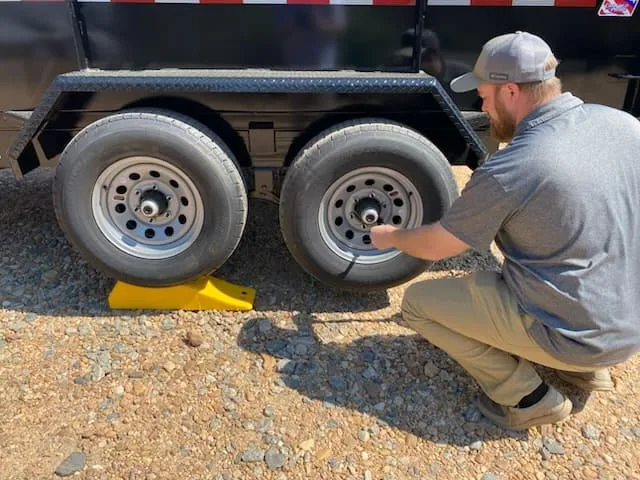
Getting a flat tire on your trailer is never convenient, but knowing how to change it can save you time, money, and stress. While the process is similar to changing a car tire, trailers have their own unique challenges, such as heavier loads and specific jack points. In this guide, we’ll walk you through everything you need to know, from gathering the right tools to safely getting back on the road. With the right knowledge and a little preparation, you’ll be ready to handle a flat trailer tire with confidence.
Got a flat? Skip to our step-by-step guide →
Tools and equipment you’ll need to change a trailer tire
Before attempting to change your trailer tire, having the right tools and equipment on hand can make the process smoother and safer. To stay prepared, keep a toolbox or storage container of tire-changing essentials in your trailer or tow vehicle. Here’s a detailed breakdown of everything you should carry in your trailer emergency kit.
Spare trailer tire
Your spare tire is your backup plan, so make sure it’s the right size and load capacity for your trailer. A mismatch could leave you stranded or cause handling issues. Regularly check its air pressure to ensure it’s ready when you need it—nothing’s worse than swapping a flat for another flat. Keep it stored in an easy-to-access spot, like a mounted tire carrier, so you’re not scrambling when the time comes.
Learn more: 5 Best Horse Trailer Tires & How to Choose
Lug wrench or tire iron
A four-way lug wrench is a great all-around tool because it fits multiple lug sizes and gives you better leverage when loosening stubborn nuts. If your lug nuts are particularly tight, a breaker bar with the correct socket size can give you the extra force needed to get them moving. Just double-check that your wrench or socket set fits your trailer’s specific lug nut size before you hit the road.
Trailer jack
Not all jacks are created equal, and the one that works for your car might not handle your trailer’s weight or height. A bottle jack rated for your trailer’s weight is a solid choice. Always check your owner’s manual to find the safest spot to lift without damaging the frame or axle.
For tandem axle trailers, use a tandem wheel ramp. It’s the safest option and eliminates the need for a jack.
Wheel chocks
Wheel chocks prevent the trailer from rolling while you're working, keeping you and your trailer safe. Heavy-duty rubber or metal chocks offer the best grip, especially on uneven or slick surfaces. Always place them on both sides of the wheel opposite the flat to keep everything stable.
Torque wrench
A torque wrench ensures that your lug nuts are tightened to the exact specifications recommended by the manufacturer. Over-tightening can damage the wheel studs, while under-tightening could cause the wheel to loosen while driving. Most trailer lug nuts should be torqued between 90 and 120 lb-ft, but always check your manual for precise numbers.
Safety gear
Having the right safety gear can make a big difference. Gloves protect your hands from grease, grime, and hot surfaces. A flashlight or headlamp is a must-have for night-time or low-light repairs, helping you see what you're doing. If you're changing a tire near traffic, a reflective vest or warning triangles make you more visible to passing drivers, keeping you safe while you work.
Other helpful tools to keep on hand
- Tire pressure gauge: Make sure the spare tire is inflated to the correct PSI. Trailer tires often require higher PSI than car tires, usually 50-80 PSI depending on the load.
- Portable air compressor: Useful for inflating a spare tire if it's low on air. A 12V compressor powered by your vehicle’s battery or a rechargeable unit works best.
- Tire repair kit: A plug kit can temporarily fix minor punctures. Sealant or a patch kit can help in emergencies, but it's not a permanent fix.
- WD-40 or rust penetrant: Helps loosen rusted or stuck lug nuts. Spray a small amount on the lugs before attempting to remove them.
- Wooden block or jack stand: A wooden board (like a 2x6) can help stabilize a jack on soft ground. A jack stand can provide additional stability when lifting a heavy trailer.
How to change a trailer tire step-by-step
Ready to get started? Follow these steps to get your trailer tire changed in no time.
1. Safety first: get ready to change the tire
Before you start changing your trailer tire, find a safe place to work.
- If you’re on the road when the flat happens, slow down and find a safe, level spot to pull over, preferably away from traffic and on solid ground.
- If you're on a highway, try to get as far onto the shoulder as possible, and always turn on your hazard lights to alert other drivers.
- If you have road flares or safety triangles, set them up behind your trailer to increase visibility, especially if it’s dark or the weather is bad.
Once you're parked, make sure the tow vehicle’s parking brake is engaged to keep everything from rolling. Grab some wheel chocks and place them around the tires on the opposite side of the flat to keep the trailer stable.
Before you start loosening lug nuts or jacking up the trailer, take a quick look around. Watch out for traffic, uneven ground, or any other hazards that could make the job riskier. If you're on a busy road with little room to work, it might be safer to call for roadside assistance rather than trying to change the tire yourself.
2. Loosen the lug nuts
Before you start lifting the trailer, you’ll want to loosen the lug nuts on the flat tire but don’t take them off just yet. Grab your lug wrench or breaker bar and turn each lug nut counterclockwise to break them loose. If they’re stuck, a little penetrating oil (like WD-40) and some extra leverage from a breaker bar can help.
Make sure to loosen the nuts in a star pattern (one, then skip to the opposite, and so on). This helps keep the wheel balanced when you remove it later. Just loosen them enough so they’re easy to remove once the trailer is lifted.
3. Lift the trailer
Now it’s time to lift the trailer by using either a jack or a tandem wheel ramp.
If using a jack:
First, find a solid part of the trailer frame to place the jack. Never position it under an axle, as that can cause damage. Your owner’s manual may have specific jack points for your trailer.
Once the jack is securely in place, start lifting until the flat tire is completely off the ground. If you’re working on soft or uneven ground, placing a sturdy wooden board under the jack can help keep it stable. Before moving forward, give the trailer a little nudge to make sure it’s secure. If anything shifts, lower it back down and readjust the jack position.
If using a tandem tire ramp:

The ramp should be placed on the same side as the flat. If the flat is on the front tire, place the ramp behind the rear axle tire. If the flat is on the rear tire, place the ramp in front of the front axle tire.
Remove the wheel chocks, and back or pull onto the tire ramp depending on its position. Replace wheel chocks snugly around the tires on the opposite side of the trailer.
4. Remove the flat tire
Now that the trailer is lifted, you can fully remove the loosened lug nuts. Keep them in a safe place so they don’t roll away. Nothing’s worse than searching for a missing lug nut in the dirt.
Once the nuts are off, carefully pull the flat tire straight off the wheel bolts. If it’s stuck due to rust or grime, a gentle kick or a tap with a rubber mallet should help loosen it. Set the old tire aside, laying it flat so it doesn’t roll away.
5. Install the spare tire
Take your spare tire and align the holes with the wheel bolts. Slide it onto the hub, making sure it sits flush against the mounting surface. If the wheel doesn’t go on smoothly, rotate it slightly to line up the holes properly.
Once the spare is in place, hand-tighten the lug nuts as much as you can. Doing this before lowering the trailer ensures the wheel stays properly aligned.
6. Lower the trailer and tighten the lug nuts
If using a jack:
Carefully lower the trailer until the spare tire is resting fully on the ground, but don’t remove the jack completely just yet. Keeping a little pressure on the jack can help stabilize things while you tighten the lug nuts.
Now, grab your lug wrench and tighten the lug nuts in the same star pattern you used earlier. This helps evenly distribute the pressure and ensures a secure fit. Once they’re snug, remove the jack completely.
If using a tandem wheel ramp:
Remove chocks from the opposite side. Depending on how the ramp is positioned, roll the trailer forward or backward so that all wheels are on the ground. Then, use your lug wrench to tighten the lug nuts in the same star pattern you used earlier.
7. Final checks
Now that the spare is on, it’s time for a few final checks before you hit the road again.
- First, properly tighten the lug nuts with your torque wrench. Follow a star pattern so the wheel sits evenly, and check your trailer’s manual for the right torque specs. After you’ve lowered the trailer completely, give the wheel a little shake to make sure it’s seated snugly and nothing feels loose.
- Next, check the tire pressure on your spare. Trailer tires usually need higher PSI than car tires, so make sure it’s inflated to the correct level. If it’s a little low, use a portable air compressor to top it off. Once everything looks good, pack up your tools, remove the wheel chocks, and store the old tire in a secure spot.
When you start driving again, take it slow for the first few miles and pay attention to how everything feels. If you notice any weird vibrations or pulling, pull over and double-check the tire. Also, make a mental note to recheck the lug nuts after about 50 to 100 miles—sometimes they settle a bit after installation.
Don’t let a flat trailer tire slow you down
Changing a trailer tire may seem daunting at first, but with the right tools and a step-by-step approach, it’s a skill every trailer owner can master. To avoid surprises, regularly inspect your trailer tires and keep your spare in top condition. By staying prepared, you can turn an unexpected flat into a quick fix rather than a major setback.
If you’re shopping for a trailer in Asheville or Greenville, SC, we’re right down the road in Campobello, SC. Come visit us, or give us a call—we’re always happy to help and answer any questions you have about safe, secure towing.
You might also like: